Multi-Shift Coordination: How to Keep Schedules Aligned Across 2nd and 3rd Shift
Every shift handoff is a scheduling reset point. The shops that run cleanly across 2nd and 3rd shift have one thing in common: a schedule that doesn't depend on the outgoing crew remembering to tell the incoming crew.
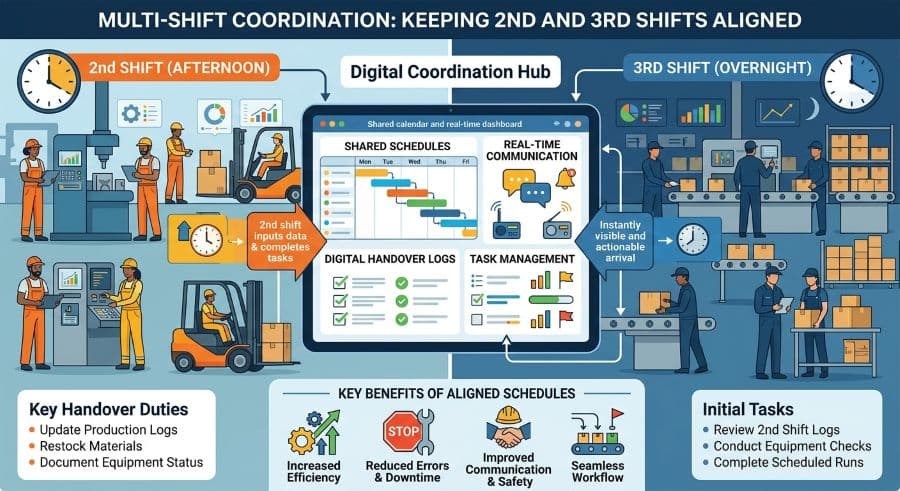
When the third-shift lead inherits a schedule he can't read
It's 11 PM. The second-shift lead just walked out, and the operator coming onto third shift is standing in front of a machine with a half-finished job, a router that doesn't match what's clamped on the table, and nobody to ask. The planner who built the schedule went home seven hours ago. The next conversation that could untangle this is tomorrow at 7 AM.
This is where multi-shift coordination breaks. Not in the planning — in the handoff.
Most shops that run a second or third shift build the schedule as if one continuous crew were working it. On paper, the plan is fine. Then a shift change happens, and the plan only survives if the outgoing crew remembers to explain it to the incoming crew: verbally, accurately, under time pressure, at the end of a long shift. That dependency is the single biggest point of failure in any 24-hour operation.
This article is about designing a schedule that survives a shift change without depending on anyone's memory — not a better handoff meeting, but a schedule the incoming crew can read cold.
Where multi-shift coordination scheduling breaks down
The schedule itself is rarely the problem. A competent planner can sequence a day's work across the machines you have. The problem is that the schedule was built for the person who built it, and at 11 PM that person is asleep.
When a job crosses a shift boundary, three things have to travel with it, and all three tend to ride in the outgoing operator's head instead of the schedule:
- Status. How far along is this job actually? "Op 20 of 40, paused mid-cycle for a tool change" is very different from "Op 20, complete, ready to index to the next machine." The schedule usually shows the job assigned to the machine. It rarely shows where inside the job the work actually stopped.
- Sequence intent. Why is this job ahead of that one? The planner had a reason — a due date, a setup carryover, a customer who called twice. If the incoming operator doesn't know the reason, they'll re-sequence on instinct the moment something goes sideways, and instinct at midnight optimizes for "what's easiest to run next," not "what ships on time."
- Exceptions. The material that came in short. The fixture that's borrowed from another cell. The note that says "run this slow, last batch chattered." These live on sticky notes, in text threads, or nowhere.
Lose any one of these at the handoff and the night shift makes a locally reasonable decision that's globally wrong. The day crew arrives to find the right machines ran all night on the wrong work.
A second shift doubles your hours — and your handoff count
The case for adding shifts is straightforward capacity math, and it's worth doing out loud because it reframes the coordination problem.
A single-shift, Monday-to-Friday operation runs roughly 40 hours a week against 168 calendar hours. Adding a second shift moves you to about 80 hours — you've doubled available machine time without buying a single machine. A third shift on a five-day week pushes you toward 120 hours; running 24/7 takes you to the full 168. You can check that math against your own week.
That's the upside, and it's real. The part shops underweight is the other number that doubles. Go from one shift to two and you've added a daily handoff. Go to three and you've added two. Every handoff is a moment where status, sequence intent, and exceptions can fall on the floor. The capacity you bought is only worth what you can coordinate across those handoffs — and multi-shift coordination scheduling, not machine time, is usually the binding constraint by the time a shop is running second shift.
This is the same dynamic that drives machine capacity planning in general: the number on the spec sheet is the ceiling, and the gap between the ceiling and your actual output is mostly coordination loss. Adding shifts widens both the ceiling and the gap at the same time.
What a night-shift schedule has to carry by itself
The fix isn't a more thorough handoff conversation. Conversations degrade — the longer the shift, the worse the recall, and the operator most likely to skip a detail is the one who's been on the floor for ten hours. The fix is to move the three things that get lost out of people's heads and into the schedule, so the schedule is the handoff.
A schedule that survives a shift change carries:
- Job state at the operation level, not the job level. "On machine 4" isn't enough. "On machine 4, op 30 running, est. complete 1:15 AM, then idle until material from outside plating returns" tells the incoming operator what to do next without asking anyone.
- The reason a job is where it is. A due date or a priority flag attached to the job — not in the planner's memory — so re-sequencing decisions made overnight respect the plan instead of overriding it blind. This is the difference between a night shift that protects on-time delivery and one that quietly erodes it.
- Exceptions where the work is, not on a sticky note. A flag on the job that says "material short — partial run only" or "borrowed fixture, return to cell 2 by day shift." If the exception lives on the schedule, it survives the handoff. If it lives on paper near the machine, it survives until someone throws the paper away.
None of this requires new software in principle — a disciplined shop can do it on a whiteboard. In practice it falls apart on a whiteboard the moment a job moves between cells, because the whiteboard for cell 2 doesn't know what cell 4 wrote. The information that has to survive a handoff is exactly the information a static board can't keep in sync. We saw this pattern up close: while we were embedded in a pressure-sensitive label manufacturer building production scheduling software, the press lines ran around the clock, and the recurring failure wasn't bad planning — it was good plans that didn't survive contact with a 2 AM shift change because the state lived with the outgoing crew, not on the schedule.
Design the handoff around the schedule, not the conversation
There's a mental model worth adopting: treat the handoff as a read, not a transfer. A transfer requires both people to be present, attentive, and accurate. A read only requires the schedule to be current and the incoming operator to look at it.
That changes what you optimize for. Instead of training crews to give better verbal handoffs — useful, but fragile — you make the schedule the authoritative record and reduce the verbal handoff to exceptions only. The outgoing operator's job at shift change shrinks to "here are the two things that aren't on the schedule yet," because everything else already is.
For this to work, the schedule has to be updated continuously through the shift, not reconstructed at the end of it. A schedule that an operator updates as work completes is current at any moment, including the moment the next operator walks in. A schedule that gets "caught up" in the last fifteen minutes of a shift is exactly as unreliable as the verbal handoff it was supposed to replace — it just moved the recall problem fifteen minutes earlier.
This is also where shift coordination connects to conflict. Most double-bookings and resequencing fights start as small mismatches that nobody reconciled across a handoff. Designing the schedule as the shared source of truth is the same discipline that drives preventing scheduling conflicts during a single shift — it just matters more across a shift change, because there's no planner on the floor to catch the mismatch in real time.
Thin overnight coverage makes every unresolved conflict more expensive
There's a second-order problem specific to nights. Most shops staff third shift lean — fewer operators, often no planner, sometimes no supervisor. That means a scheduling conflict that surfaces at 2 AM has fewer people who can resolve it and no one with the authority or the full picture to re-plan around it.
A scheduling conflict that reaches the floor — a double-booked machine, a job that can't start because its predecessor isn't done — costs roughly $250 to $1,000 per incident in machine restart, resequencing, and lost capacity (Product Brief §2). On day shift, someone catches it and absorbs the cost in minutes. On third shift, the same conflict often sits unresolved until morning because the people who could fix it aren't there. The per-incident cost is the same; the duration of the damage is longer, and an idle machine overnight is capacity you're paying for and not getting.
The implication for second-shift production schedules and third-shift coordination is that the overnight schedule has to be more robust than the day schedule, not less — precisely because it has thinner human backup. The schedule has to anticipate the conflict the absent planner would otherwise catch. That means front-loading the work that's least likely to hit an exception, sequencing jobs that depend on outside operations (plating, heat treat, inspection) so they don't strand the night crew waiting on something that won't arrive until day shift, and flagging the handful of jobs that genuinely need a judgment call so the lead knows where to spend their limited attention.
A short checklist for shift-proofing your schedule
If you run more than one shift, walk your current schedule against these:
- Can an operator who wasn't here yesterday read the schedule and know what to run next, in what order, and why — without asking anyone?
- Is job status tracked at the operation level, not just "assigned to this machine"?
- Do priority and due-date reasons live on the job, or in the planner's head?
- Are exceptions (short material, borrowed fixtures, run-slow notes) attached to the job on the schedule, or floating on paper?
- Is the schedule updated as work completes, or reconstructed at the end of each shift?
- Does the overnight sequence avoid stranding the thin night crew on jobs that depend on day-shift-only operations?
Every "no" on that list is a place where your multi-shift coordination depends on someone remembering to talk. The goal of multi-shift coordination scheduling isn't to make the handoff conversation better. It's to make the schedule good enough that the conversation barely matters.
Where to take this next
The shops that run cleanly across 2nd and 3rd shift didn't get there by hiring better communicators. They got there by building a schedule the next crew can read without a briefing — one that carries status, sequence intent, and exceptions on the job itself, and stays current through the shift instead of getting reconstructed at the end of it.
If you want a deeper treatment of how shift structure interacts with machine sequencing, shift scheduling for CNC machining goes further on the sequencing side. And if you're still coordinating shifts through a spreadsheet that lives on one person's screen, our downloadable scheduling tools are a reasonable place to start tightening the handoff.
Want to see what a shift-proof schedule looks like in your own shop? Start a free trial of Visual Machine Scheduler — drag-and-drop scheduling that every shift reads from the same board, updated as work happens. No credit card required, 14-day trial.
Ready to go beyond the guide?
Most shops are on a live Gantt board within 60 minutes of sign-up, with their existing job list imported from Excel.
Get shop floor scheduling guides in your inbox
Practical articles for production managers — no spam, unsubscribe anytime.