The True Cost of Unplanned Machine Downtime in a Job Shop (It's 35% More Than You Think)
Unplanned downtime doesn't just cost the hours the machine is stopped — it costs the resequencing labor, the emergency overtime, and the customer relationship damage.
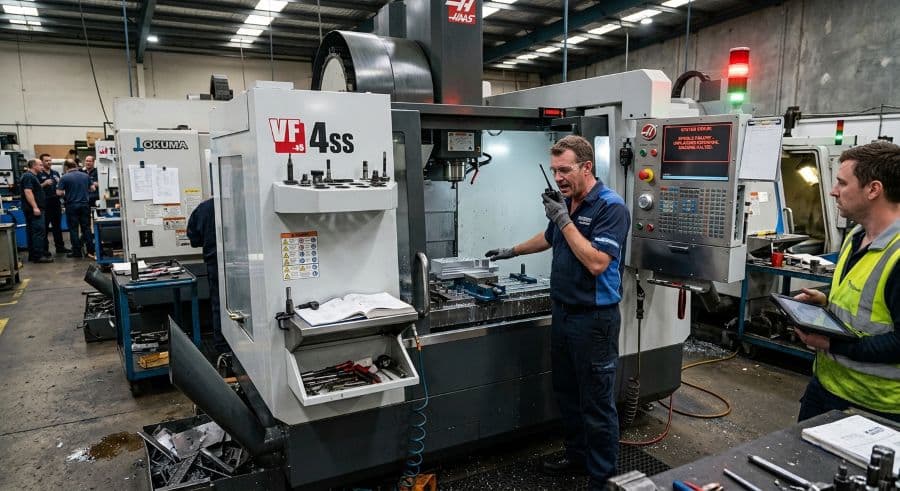
A spindle faults at 9:40 on a Tuesday. The bill doesn't stop at the spindle.
A tool snaps mid-cut. A servo throws an alarm. A coolant pump dies and nobody notices until the part scorches. The machine sits dark for ninety minutes while someone diagnoses it, and your shop prices that incident the only way most shops know how: ninety minutes times the machine's hourly rate. Call it a couple hundred dollars and move on.
That number is wrong, and not by a rounding error. Unplanned downtime runs about 35% more expensive than planned downtime (Arda Cards 2026). The extra cost isn't a surcharge bolted onto the stopped machine. It's everything the stoppage knocks over on its way through the rest of your schedule — the resequencing, the overtime, the expedite, the customer who now has a reason to scrutinize your next quote.
This article breaks down where that 35% actually hides, gives you a worked example you can run against your own shop floor, and makes the case that a job shop's real exposure to the cost of unplanned downtime in manufacturing is a scheduling problem wearing a maintenance costume.
The hourly-rate method undercounts on purpose
The standard way to price a stoppage is stopped hours multiplied by the machine's burdened rate. It's clean, it's defensible in a meeting, and it captures maybe two-thirds of what the event actually cost you.
The method's flaw is that it treats the machine as an island. In a high-volume plant running one part across a dedicated line, that's almost fair — the line is down, the line comes back, you lost the hours in between. A job shop doesn't work that way. Every job on a machine is sequenced ahead of and behind other jobs, on other machines, against other due dates. The machine that just faulted was the third operation on a five-operation part that's promised Friday, and the parts queued behind it were staged in an order that assumed this machine would be free at 10:00.
So when the hourly-rate method prices the stoppage, it's pricing the hole in the schedule. It isn't pricing the damage to everything arranged around the hole. That damage is the cascade, and the cascade is where the 35% lives.
The cascade: where the other 35% hides
When an unplanned stoppage lands on a brittle schedule, the cost shows up in four places that the hourly-rate method never touches.
Resequencing labor. Someone has to re-plan the floor. The lead, the planner, or — in most shops under 50 people — the owner stops what they're doing, figures out what slides, decides which jobs jump machines, and tells the floor the new order. A single scheduling conflict that reaches the floor costs $250–$1,000 in machine restart, resequencing, and lost capacity (Product Brief §2). That's not the cost of the broken tool. That's the cost of the decision that the broken tool forced.
Emergency overtime. The hours the machine ate don't evaporate; they get clawed back. That means a Saturday shift, or two operators staying until 7:00, or a second-shift run that wasn't on the books that morning. You pay a premium rate to recover hours you'd already paid for once.
Expedite and recovery costs. When recovery isn't enough, the shipment splits. Premium freight to hit the date. A partial shipment now and the balance next week, which means double the packaging, double the paperwork, and an AP department on the other end that's annoyed at two invoices for one PO.
Customer relationship damage. This is the one nobody books and everybody feels. The job ships late, or it ships complete but the next three jobs from that customer come with tighter follow-up. A buyer who used to take your dates at face value now asks for confirmation. None of that hits a cost center, but it's the most expensive line in the cascade over a year.
It's also the line that compounds. A plant ships the same part to the same customer on a standing schedule; a missed date is a one-time apology. A job shop lives on repeat business won quote by quote, and a buyer's confidence in your dates is most of what you're actually selling. When an unplanned stoppage burns a delivery, the cost isn't the one late job — it's the discount you'll eat on the next quote to win back a customer who's now hedging. That doesn't show up for a quarter, which is exactly why the hourly-rate method can't see it.
Stack those four on top of the stopped-machine hours and you land roughly where the data says you'll land: about a third more than the naive number.
Planned downtime is cheaper because the schedule already knew
Here's the cleanest way to see why unplanned downtime carries that premium. Take the exact same lost hour and schedule it.
A preventive-maintenance window booked for 6:00 AM Saturday costs you the same machine-hours as an unplanned fault that eats the same time. But the bill is completely different, because the schedule absorbed it in advance. Nothing got resequenced — the jobs were already planned around the gap. No emergency overtime — the recovery was built in. No expedite, because no due date was ever at risk. No surprised customer, because no promise moved.
The mechanism is queue absorption. When you plan a stoppage, you let the work queue flow around it: jobs get sequenced so the gap falls where it does the least damage, and the hours come out of slack you chose to spend. An unplanned stoppage spends that same slack involuntarily, at the worst possible moment, and forces a human to rebuild the queue in real time while the floor waits. The lost capacity is identical. The chaos tax is not.
Same lost hour. Different bill. The 35% premium (Arda Cards 2026) is the structural difference between a stoppage your schedule anticipated and one it didn't. Which is also the reason the premium is mostly within your control — not by preventing every fault, but by changing how much each fault costs when it happens.
A worked example you can run on your own shop
Forget the industry averages for a minute and price a real incident on your floor. You don't need a fancy machine downtime cost calculator for the first pass — you need five numbers you already know.
Say a machine faults and is down 3 hours. Start with the number every shop computes:
- Direct stopped-machine cost: 3 hours × your burdened machine rate. If that rate is, say, $85/hour, that's $255. This is the whole bill under the hourly-rate method.
Now add the cascade, using your own figures:
- Resequencing: the planner and a lead spend 45 minutes re-planning the floor. Their loaded labor for that 45 minutes plus the restart cost on the machines that had to be re-fixtured. Even at the low end of the sourced range, call it a few hundred dollars (Product Brief §2).
- Overtime recovery: if those 3 hours get recovered on a weekend shift, the premium portion of that labor — the difference between straight time and the overtime rate for whoever runs it.
- Expedite: if the slip threatens a Friday date and you pay for next-day freight, the delta between your normal freight and the expedited rate.
Add the four lines. For most shops the cascade lines come out near or above the direct line — which is the whole point. The $255 you'd have booked is the smallest number on the page. Run this once, on a real incident, and you'll never trust the hourly-rate method again. (If you want to put a per-hour figure on it for budgeting, this is exactly how you derive a defensible downtime cost per hour for your manufacturing operation: total incident cost ÷ stopped hours, averaged across a quarter of real events.)
Why job shops are more exposed than plants
A high-volume plant has slack the way a job shop never does. Dedicated lines, buffer inventory, and a maintenance schedule built around takt mean a stoppage has somewhere to be absorbed. A job shop is the opposite environment: high-mix, low-volume, shared machines, and due dates measured in days, not weeks. This isn't a niche problem — there are 16,627 machine shops in the United States alone (NAICS 332710, Census County Business Patterns), and nearly all of them run this way.
That structure is what makes the cascade so steep. When every machine is shared across a dozen open jobs and the schedule lives in a spreadsheet or on a whiteboard, a single fault can't be re-planned in thirty seconds — and the hidden cost of scheduling that work manually is already running 5–10% of revenue before anything breaks (Qlector 2025). Add an unplanned stoppage to a schedule that's hard to change, and the resequencing line balloons because resequencing is genuinely hard to do.
It also quietly wrecks your numbers. Availability is the first term in the OEE calculation — Availability × Performance × Quality — and unplanned downtime is the largest, lumpiest drain on it. A shop that can't separate planned from unplanned stoppages in its records can't tell whether its availability problem is a maintenance problem or a scheduling one. Usually it's both, and the scheduling half is the cheaper one to fix.
How to shrink the unplanned-downtime premium
You're not going to eliminate faults. The lever that's actually in reach is the premium — the 35% of extra cost that comes from the cascade, not the stoppage. Four moves shrink it.
Measure the real number, not the hourly-rate number. Track total incident cost — direct plus cascade — for a quarter of real stoppages. Once you've got a defensible per-hour figure, every downtime conversation stops being a guess.
Separate planned from unplanned in your records. A PM window and a surprise crash are not the same line item, and lumping them hides the only number you can actually move. The premium only becomes visible once the two are split.
Build buffer where it's cheap. Slack on your constraint machine costs you a little utilization on paper and saves you the entire cascade when something faults. The shops that recover gracefully aren't the ones with the newest equipment — they're the ones whose schedule had somewhere to put the hit.
Make the schedule resequenceable. This is the big one. If re-planning the floor after a fault is a forty-five-minute, owner-stops-everything event, every stoppage triggers the full cascade. If it's a drag-and-drop that takes two minutes and shows you the downstream impact before you commit, the resequencing line shrinks toward zero — and so does the overtime and expedite that flowed from it. A schedule you can change quickly is the single cheapest insurance against unplanned downtime cost a job shop can buy. The shops that hold their dates through breakdowns are usually the same ones posting better on-time delivery numbers across the board.
What to do with this
The cost of unplanned downtime in manufacturing isn't the stopped machine. It's the schedule the stopped machine breaks — the resequencing, the overtime, the expedite, and the customer who now double-checks your dates. Plant operations absorb that hit; job shops eat it, because their schedules are tight and hard to change. The 35% premium (Arda Cards 2026) is real, and most of it is within reach.
Start by pricing one real incident the way this article lays out, then put a number on what it's costing your shop over a year. The ROI calculator does the second part for you — plug in your shop size and machine rate and it returns the annual figure, cascade included. If you'd rather start from a spreadsheet template you can keep, the downtime and scheduling cost tools in the store cover the same math.
And if the part you want to fix is the resequencing line — the cost that comes from a schedule you can't change fast enough — that's the part a visual scheduler is built to remove. You can try it on your own shop's jobs free for 14 days, no credit card, and see what a two-minute resequence does to the bill the next time a spindle faults at 9:40 on a Tuesday.
Ready to go beyond the guide?
Most shops are on a live Gantt board within 60 minutes of sign-up, with their existing job list imported from Excel.
Get shop floor scheduling guides in your inbox
Practical articles for production managers — no spam, unsubscribe anytime.
Related articles
OEE Calculation for Manufacturers: A Plain-English Guide with Examples
OEE is the most important machine metric most job shops never track. Availability × Performance × Quality = your real ma…
How to Calculate Machine Utilization Rate (With Free OEE Template)
Machine utilization rate is one of the most important metrics in a job shop, but most production managers have no reliab…
Machine Capacity Planning for Job Shops: How to Know What You Can Actually Take On
The most expensive words in a job shop: "Yeah, we can do that by Friday." Capacity planning means knowing before you com…