Scheduling an API-Certified Machining Operation: Traceability and Documentation Considerations
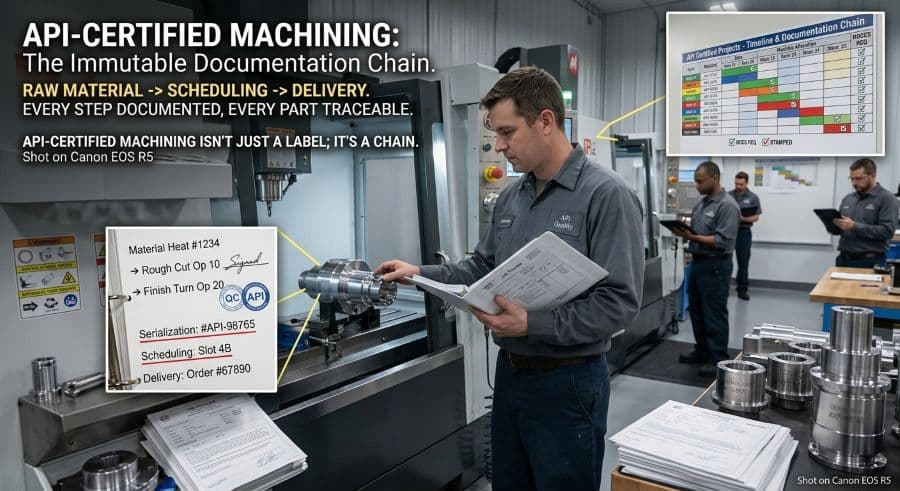
API-certified machining isn't just a quality label. It's a documentation chain that has to follow every part from raw material to delivery — and scheduling is part of that chain.
A part can pass every dimension and still fail at the dock
A part fails its final inspection at receiving — not on dimensions, but on paperwork. The machining is good. The material is right. But somewhere between the heat lot that arrived in March and the order that shipped Friday, the traceability link broke. The customer's receiving inspector won't accept the part without a complete documentation package, and now the question isn't whether you can make the part. It's whether you can prove the one in the crate is the one the paperwork describes.
That is the part of API-certified work that catches shops off guard. The certification isn't a sticker on the wall. It's a documentation chain that has to follow every part from raw bar stock to delivered hardware, and it has to stay intact through every reschedule, every expedite, and every material substitution on the floor. The schedule is where that chain most often breaks — because the schedule is the one place where parts, material, and sequence all get reassigned under pressure.
This article is about API-certified machining scheduling: what the documentation chain requires, where it tends to fail, and what a schedule has to carry so the paperwork survives a busy week. It is not compliance advice — the specifics belong to your auditor and your customer's purchase order.
What API certification actually adds to a production order
Two API documents shape most machining work in the oilfield supply chain, and they do different jobs.
API Q1 is the quality management system specification for organizations manufacturing product for the petroleum and natural gas industry. It governs how the shop controls its processes and its records — including traceability and the retention of objective evidence that the part was made the way the documentation says. API Q1 production scheduling, in practice, means the schedule has to live inside a system where every order leaves a record trail, not just a finished part.
API 6A (also published as ISO 10423) is the product specification for wellhead and christmas tree equipment. It introduces Product Specification Levels — commonly PSL 1 through 4 — that escalate the inspection, testing, material, and traceability requirements as the level goes up. A PSL 3 component carries heavier documentation and tighter material traceability than a PSL 1 component of the same geometry. So API 6A scheduling isn't one rule; it's a sliding scale, and two parts that look identical on the print can carry very different paperwork obligations.
Underneath both is the same operational reality: material identity has to be preserved. Raw material arrives with a heat or lot number and a material test report (MTR). That identity has to stay attached to the part through cutting, turning, milling, any heat treatment, inspection, and shipment — so that the finished part's documentation package ties back to the specific heat it came from. The higher the PSL, the less the standard tolerates a gap in that chain.
None of that is exotic on its own. What makes it hard is that it has to hold up while the shop is doing everything else a job shop does: splitting bars across orders, resequencing for a hot job, swapping a machine when one goes down. Oilfield certification traceability isn't a problem when nothing changes. It's a problem precisely because the floor changes constantly.
Where the documentation chain breaks: at the schedule, not the spec
Most shops don't lose traceability in the quality manual. They lose it on the floor, on a Thursday, when the schedule moves.
Here is the common failure pattern. A bar of certified material is logged in with its heat number. It gets cut for Order A. Then Order B becomes urgent, someone pulls the remaining length of that same bar for B, and the heat number gets re-recorded by hand — or doesn't. A week later, two orders claim material from one heat, the cut log and the schedule disagree about which order got which piece, and the documentation package for one of them can no longer be reconstructed with confidence.
That is a scheduling event, not a quality-system event. The decision to reassign material happened in the act of resequencing work. If the schedule doesn't carry the material identity with the job, the reassignment silently breaks the chain.
The cost shows up later and is larger than it looks. A scheduling conflict that reaches the floor — a resequence, a machine restart, a job pulled and re-fed — runs $250–$1,000 per incident in lost capacity and rework (Product Brief). For a certified shop, the same incident carries a second bill: the documentation has to be reconciled, the affected parts may need re-inspection or quarantine, and in the worst case the part is scrapped not because it's bad but because it can no longer be proven good. A part you can't document is, for an API customer, a part you can't ship.
This is why the schedule matters to certification at all. The schedule is the system of record for what's running where, in what order, on which material. When it's a whiteboard or a spreadsheet, that record is detached from the traceability data — and every reschedule is a chance for the two to drift apart.
Why detached scheduling and traceability don't mix
Spreadsheet and whiteboard scheduling have one structural weakness for certified work: they hold sequence, but not identity.
A spreadsheet row can tell you Order A runs on Machine 3 Tuesday. It does not, on its own, carry the heat number, the MTR reference, the PSL, the required hold points, or the inspection status of that order — and even when someone adds those columns, they're maintained by hand and updated separately from the cut log, the traveler, and the inspection records. The moment the schedule changes, all of those hand-kept references have to be updated in lockstep, in multiple places, by people under deadline pressure. They won't be. That's not a discipline problem; it's a structure problem.
ERP-based scheduling can carry the data, but in many job shops the scheduling module is the part of the ERP that fits the shop worst — it assumes infinite capacity, or it can't model the real constraints (one operator who runs three machines, a single heat-treat slot, a customer-mandated witness point), so the floor goes back to the whiteboard for the actual sequencing and the ERP holds the records. Now you have two systems: one that knows the traceability data and one that decides what actually runs. The gap between them is exactly where the chain breaks.
The point isn't that one category of tool is good and another is bad. It's that for API-certified work, the scheduling decision and the traceability data cannot live in separate systems that have to be reconciled by hand. When they're separate, the schedule wins the argument on the floor and the records get reconstructed afterward — which is the opposite of traceability.
What API-certified machining scheduling has to track
If the schedule is going to protect the documentation chain rather than threaten it, each job on the board has to carry more than a part number and a due date. At minimum, the schedule needs to know — and keep attached to the job through every move:
- Material identity — the heat or lot number and a reference to its MTR, so a resequence or a split carries the material identity with it instead of orphaning it.
- Product Specification Level — the PSL (or equivalent customer requirement), because it determines how much documentation and inspection the job demands and therefore how much float to leave around it.
- Material class and rating — the API material class, temperature, and pressure ratings called out on the order, so a substitution can't quietly violate the spec.
- Hold and witness points — the mandatory inspection gates, including any customer- or third-party-witnessed steps, which are fixed sequence constraints, not optional buffers.
- Inspection and NCR status — whether the job is cleared to advance, on hold, or in nonconformance, so a quarantined part can't be accidentally resequenced back into the flow.
The discipline this enables is simple to state and hard to do on a spreadsheet: nothing advances past a hold point until the prior gate is signed off, and material identity travels with the work no matter how the sequence changes. A schedule that tracks these fields turns traceability from a paperwork exercise done after the fact into a constraint the schedule enforces while the work runs. For the broader picture of running oilfield work as discrete, document-heavy jobs rather than continuous production, see our take on project-based scheduling for oil and gas machining.
Scheduling around hold points and inspection gates
Hold points are the constraint that most distinguishes certified scheduling from ordinary job-shop scheduling.
An ordinary schedule treats inspection as a quick step between operations. A certified schedule has to treat mandatory hold points — and especially witnessed hold points, where a customer or third-party inspector has to be present — as hard sequence locks. Work physically cannot proceed until the gate is signed, and a witnessed gate adds a second calendar to coordinate: the inspector's availability, not just the machine's. Higher PSL work tends to carry more of these gates, which is one reason API 6A scheduling at PSL 3 or 4 needs more planned float than the same part at PSL 1.
This changes how you protect a due date. On uncertified work, you protect the date by keeping the machine busy. On certified work, you protect the date by protecting the gates — making sure the part reaches each hold point with enough buffer that an inspection delay, a witness no-show, or a documentation correction doesn't cascade into a missed ship date. The bottleneck is often the inspection calendar, not the spindle.
It also changes how you handle the inevitable expedite. When a hot job jumps the queue, the rule for certified work is that the documentation linkage and the hold-point obligations move with it. You can resequence the work; you cannot resequence away the gates. A schedule that lets a job skip a witnessed inspection to make a date hasn't saved the date — it's created a part that can't be documented. The same demand swings that make oilfield work spiky also make this tempting, which is why managing capacity for oilfield demand swings and protecting hold points have to be solved together rather than one at the expense of the other.
Certification regimes all push scheduling the same direction
API is not unique in this. Any certification that demands traceability and documented process control pushes scheduling toward the same place: identity attached to the job, gates that can't be skipped, and a single record of what ran where. Automotive shops under IATF 16949 face a structurally similar problem with their own documentation and PPAP discipline — the regime differs, but the scheduling implication is the same, as we cover in scheduling for an IATF-certified machine shop. If your shop runs both oilfield and automotive work, the good news is that a schedule built to protect one certification's traceability is most of the way to protecting the other's.
What changes between regimes is the specific evidence required and how long it has to be retained. What stays constant is that the schedule has to stop being a separate, disposable artifact and start being part of the record.
Where this leaves your shop
API certification doesn't change what you machine. It changes what you have to be able to prove about what you machined — and the proof has to survive every reschedule between raw material and the dock. The shops that struggle aren't the ones with weak machining. They're the ones whose schedule and traceability data live in different places and get reconciled by hand under pressure, which is also where a meaningful share of revenue quietly leaks: 5–10% of revenue is a common estimate for what manual, disconnected scheduling costs a typical job shop (Qlector 2025).
The fix is structural, not heroic. Done right, API-certified machining scheduling keeps material identity, PSL, hold points, and inspection status attached to the job on the schedule itself, so the documentation chain is enforced by the way work moves rather than rebuilt after it moves.
The specifics — which traceability granularity your PSL requires, how long records must be retained, what your customer's purchase order adds on top of the API baseline — belong to your auditor and your customer, and you should verify them there rather than against any single article. What's general is the scheduling principle: the schedule is part of the traceability chain, so treat it like a controlled record.
If you want a starting point for the trackers and templates that sit around a certified job, the tools in our store are a low-commitment place to begin. And if you'd rather see material identity, hold points, and inspection status carried on a live schedule instead of in a spreadsheet you maintain by hand, start a free trial of MachineScheduler — 14 days, no credit card required.
Ready to go beyond the guide?
Most shops are on a live Gantt board within 60 minutes of sign-up, with their existing job list imported from Excel.
Get shop floor scheduling guides in your inbox
Practical articles for production managers — no spam, unsubscribe anytime.
Related articles
Project-Based Scheduling for Oil & Gas Machine Shops: When the Rig Count Drives Demand
Oil & gas machining doesn't run on a manufacturing-belt rhythm. It runs on rig counts, capital project gates, and well c…
Long-Cycle Job Scheduling for Mold & Die Shops: The 12-Week Build Problem
Mold and die shops are the longest-cycle work in machining. A single program can occupy a machining center for 6–14 week…
Mixed-Portfolio Scheduling: Balancing Short Runs, Long Runs, and Repair Work
Textbook scheduling assumes you're either high-mix-low-volume or low-mix-high-volume. Real job shops are both, often on …