Managing Elastic Capacity in Oil & Gas Machining: From Boom to Bust and Back
Oil & gas machining shops don't manage demand — they manage capacity around demand they can't control. Boom-bust cycles are the operating environment, not the exception.
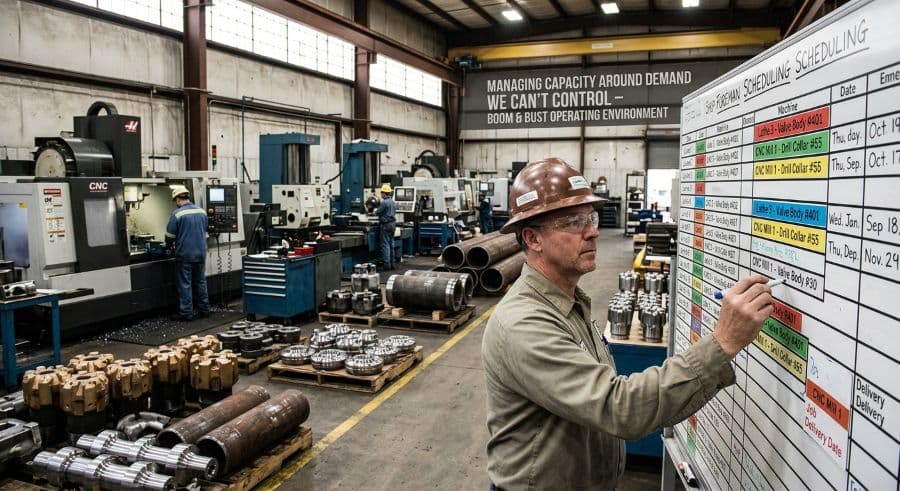
The oilfield doesn't reward you for predicting the cycle
Between mid-2014 and February 2016, West Texas Intermediate fell from roughly $107 a barrel to $26.21 (EIA). Over the same window, the U.S. rig count dropped from about 1,900 to around 400 (Baker Hughes) — close to an 80% collapse in active drilling. Four years later it got worse: in April 2020 the front-month WTI contract settled at -$37.63, the first time it traded below zero since futures trading began in 1983 (EIA). The rig count bottomed at 244 that August, a record low in a series Baker Hughes has published since the 1940s (Baker Hughes).
If you machine parts for oil and gas — wellhead components, valve bodies, downhole tools, API-spec connections — those are not market headlines. They are your order book, twelve to eighteen months early.
The reflex is to get better at forecasting the swing. That's the wrong project. You will not out-predict OPEC production decisions, a geopolitical shock, or a global demand shift. What you can control is how your own shop responds when the cycle turns. That is what oil & gas elastic capacity actually means: building a shop whose capacity bends with the cycle instead of breaking against it. This article covers what to hold fixed, what to let flex, and how to read the cycle early enough to act before it lands on your floor.
A demand you can't forecast, a response you can build
Most scheduling advice assumes demand is roughly knowable — seasonal, trending, lumpy but legible. Oilfield machining demand is none of those things in a way you can plan around. You sit two steps removed from a commodity price set outside your control. Operators drill in response to price; you cut metal in response to operators. By the time a price move reaches your quote pipeline, the decision that caused it was made quarters ago in a boardroom you'll never see.
So the useful unit of management is not the oilfield demand cycle itself. It's your elasticity against it. Capacity management in oil & gas is the discipline of sizing, structuring, and scheduling your shop so that a 50% swing in incoming work doesn't take you out at either end. That reframing matters because the two ends fail in opposite directions, and most shops are only built to survive one of them.
Fixed capacity punishes you at both ends
A shop with rigid capacity loses money in a boom and loses money in a bust. Different mechanisms, same root cause.
In the trough, capacity you built for the peak becomes a liability. Machines you financed at the top sit idle while the loan payments don't. Skilled operators you can't afford to lose draw full wages against a half-full schedule. The unplanned, reactive scrambling that comes with a collapsing order book has its own cost: unplanned downtime runs about 35% more expensive than planned downtime (Arda Cards 2026), and a shop in survival mode is improvising constantly.
In the boom, rigid capacity costs you the opposite way. Work shows up faster than you can take it, and every job you turn away is a customer who finds another shop — one who may keep that customer when the next trough makes relationships sticky. The hidden tax on top of this is scheduling friction: manual scheduling quietly consumes 5–10% of revenue in a typical job shop, which works out to roughly $128,000–$276,000 a year for a $2M shop once the full cost picture is added up (Qlector 2025). In a boom, that drag is the difference between capturing the upside and drowning in it.
Fixed capacity assumes you know which world you're living in. In oil and gas, you routinely get both inside eighteen months.
Elastic capacity is a set of levers, not a slogan
Flexible capacity machining isn't one decision. It's a handful of independent levers, each of which you can pull part-way. The goal is to assemble enough of them that your effective capacity can move with demand without forcing you to buy or sell iron at exactly the wrong point in the cycle.
- Cross-trained operators. Workforce flexibility is the cheapest elastic lever you have. An operator who runs three machine types is capacity you can redeploy in a day; one who runs a single cell is not. Cross-training widens the range of work you can absorb without hiring.
- General-purpose machine choices. A flexible machining center that can take varied work holds value across the cycle better than a dedicated line tuned for one part family that disappears when that customer's program does.
- Subcontract overflow. A standing relationship with two or three trusted shops lets you take boom work you can't fully run yourself, then pull it back in-house when your own machines have open hours. You rent capacity at the peak instead of owning it through the trough.
- Shift elasticity. Adding or dropping a shift is a large, fast capacity move. A single-shift operation runs roughly 40 of the 168 hours in a week; a second shift nearly doubles available machine hours without a single new machine. The math is yours to check, and it's the highest-leverage flex most shops underuse.
- Capital discipline. The industry's own behavior is instructive here. After the 2014–2016 and 2020 collapses, U.S. drilling settled into a lower, steadier equilibrium — the rig count has held broadly in the 550–650 range through 2024–2026 rather than chasing every price spike (Baker Hughes). Shops can borrow the same posture: size your fixed base conservatively and flex the rest.
- Vertical diversification. The most durable elasticity is not being 100% oilfield. A shop that also serves a steadier vertical has a floor under its schedule when drilling stops. A regional contract shop that built capacity around tooling work, for instance, carries a different demand profile entirely — the kind of mold and die work covered in our Chicago–Rockford shop profile doesn't move with the rig count at all.
No single lever makes you elastic. Three or four of them, sized deliberately, do.
You can't flex capacity you can't see
Every lever above depends on one thing: knowing, at any moment, exactly how loaded your shop actually is. Elasticity is a scheduling problem before it's a capacity problem.
This is where most oilfield shops are blind. Spreadsheets and whiteboards tell you what's scheduled, not what's possible. They don't show you the open hours hiding on a machine three rows down, the conflict that's about to collide two rush jobs on the same spindle, or the realistic date you can actually promise when a boom-time customer calls. A scheduling conflict that reaches the floor costs $250–$1,000 per incident in restarts, resequencing, and lost capacity (Product Brief), and in a boom you generate those conflicts faster than you can resolve them by hand.
Finite-capacity scheduling closes that gap. When you can see every machine's true load against its real available hours, the elastic levers become operable: you know when to call the subcontractor, when the second shift earns its cost, and when you have room to say yes. Oilfield work also tends to run as projects — multi-operation jobs with sequencing and due-date dependencies — which is its own scheduling discipline, covered in project-based scheduling for oil and gas shops. And before you can flex capacity intelligently, you need a baseline measure of what you have, which is the work in our machine capacity planning guide.
Visibility is the precondition. Without it, every flex decision is a guess.
Core capacity vs. surge capacity
The practical framework is to split your shop into two layers and manage them on different rules.
| Layer | What it is | How you size it | How you flex it |
|---|---|---|---|
| Core capacity | Machines, operators, and shifts you keep through the trough | Sized to trough-level demand plus a modest margin — not to the peak | Held fixed; protected through the down cycle |
| Surge capacity | Capacity you add only when demand warrants | Zero baseline cost; activated on demand | Overtime, added shift, subcontract, temp operators |
The core is what you finance, employ, and defend through a downturn. Size it to the demand you expect at the bottom of the cycle, not the top, and add only enough margin to keep your best people and your most versatile machines busy when drilling stalls. Everything above that line is surge — capacity you switch on with overtime, a temporary shift, or a subcontractor, and switch off again without carrying it through the next trough.
The mistake that bankrupts oilfield shops is financing surge demand with core capacity: buying machines at the peak to chase boom orders, then owning the debt when the boom ends. Hold the core lean; rent the surge.
One layer that doesn't flex cleanly is certification scope. If your boom work is API-spec or otherwise certified, the qualified processes, documentation, and operator competencies behind it aren't something you spin up overnight or subcontract casually — there are real scheduling implications, which we cover in API-certified machining scheduling considerations. Treat certified capacity as part of your protected core, and verify any specific certification requirements with the relevant certifying body rather than assuming a subcontractor can absorb that work.
Read the leading indicators so you flex early
The advantage of oilfield cyclicality is that it telegraphs. The rig count is a leading indicator by design — it tells you what's being drilled now, ahead of the production and order activity that follows (Baker Hughes). Drilling activity moves before your quote pipeline does, which means the data is published well before the work, or the absence of it, reaches your floor.
That lag is your window. A shop watching rig-count and frac-spread trends can begin adding surge capacity as activity climbs, instead of scrambling after the orders already landed. More importantly, it can begin pulling surge capacity back as the leading indicators roll over, protecting cash before the trough arrives rather than absorbing idle machines on the way down. Flexing early is the entire game. Flexing late means you build capacity into a boom that's already ending and shed it into a recovery you didn't see coming.
What this means for your shop
Oil and gas machining isn't a business where you win by predicting demand. You win by being the shop that stays solvent through the peak and the trough — the one still standing, and still holding its customers, when the cycle turns again. That's what elastic capacity buys you: not immunity from the swing, but the ability to take the upside without betting the company on it and to survive the downside without gutting the team you'll need next time.
The starting point is honest visibility into your real capacity, because every elastic lever depends on it. If you want a structured way to measure where your shop's capacity sits today, the machine capacity planning guide and the worksheets in our store are a reasonable first step.
If you'd rather see your actual machine load instead of estimating it, that's what the tool is built for. Visual Machine Scheduler shows finite capacity across every machine in a drag-and-drop schedule, so you can see open hours, catch conflicts before they hit the floor, and make surge-versus-core decisions on real numbers. Start a free trial — 14 days, no credit card — and load a week of your own jobs to see where your capacity actually stands before the next swing makes the decision for you.
Ready to go beyond the guide?
Most shops are on a live Gantt board within 60 minutes of sign-up, with their existing job list imported from Excel.
Get shop floor scheduling guides in your inbox
Practical articles for production managers — no spam, unsubscribe anytime.
Related articles
The True Cost of Unplanned Machine Downtime in a Job Shop (It's 35% More Than You Think)
Unplanned downtime doesn't just cost the hours the machine is stopped — it costs the resequencing labor, the emergency o…
OEE Calculation for Manufacturers: A Plain-English Guide with Examples
OEE is the most important machine metric most job shops never track. Availability × Performance × Quality = your real ma…
How to Calculate Machine Utilization Rate (With Free OEE Template)
Machine utilization rate is one of the most important metrics in a job shop, but most production managers have no reliab…