Detroit's Auto-Tier Machine Shops: Inside the Tier 2 and Tier 3 Supply Base
Detroit's tier 2 and tier 3 auto-supply machine shops live by a different rhythm than general job shops — EDI-driven releases, JIT pressure, and IATF 16949 quality requirements all compress the scheduling window.
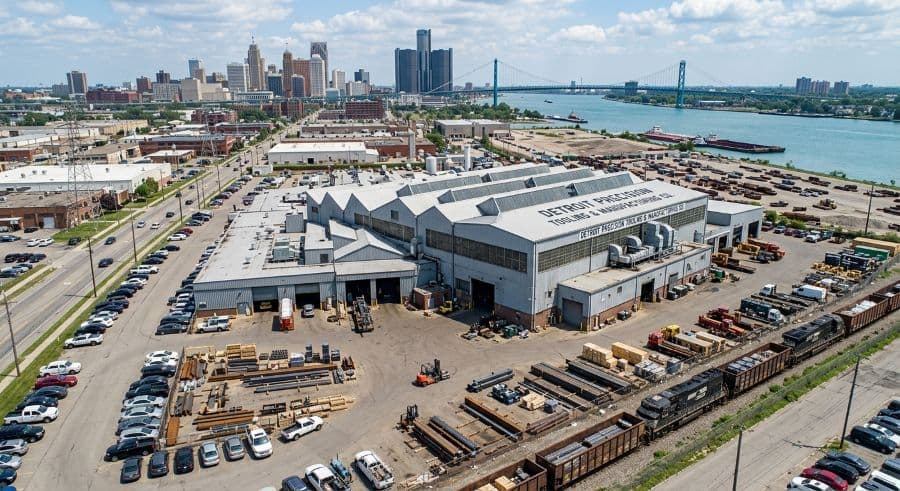
When the schedule changes before anyone picks up the phone
In most contract machining shops, the schedule changes when a customer calls to move a date. In a tier 2 or tier 3 auto-supply shop feeding Detroit's OEMs, it changes when a planning system on the other end of an EDI connection pushes a new release — and nobody calls. Quantities shift, ship dates compress, and the week you laid out on Friday is stale before first shift Monday.
That is the defining condition of an auto-tier machine shop. You don't fully own your own schedule. You inherit it, in rolling weekly increments, from a customer whose assembly line cannot stop and whose tolerance for a late part is measured in minutes, not days.
Most general job shops have never operated under that constraint. The auto-tier base does, every week, and it shapes everything from how a shop quotes capacity to how it staffs second shift.
This is a look at how that supply base actually runs: how the tiers fit together, why electronic releases and IATF 16949 turn scheduling into a moving target, and what separates the shops that absorb OEM pressure from the ones it slowly grinds down.
What machine shops in Detroit, Michigan actually supply
Detroit is the historic center of North American vehicle production, and the machining base that grew up around it is organized in tiers. A tier 1 supplier ships finished systems and modules straight to the OEM — seat structures, brake assemblies, instrument panels. A tier 2 supplier makes the components that go into those systems. A tier 3 supplier provides the raw and semi-finished inputs further upstream: stampings, castings, machined parts, and the tooling that makes all of it repeatable.
Most independent machine shops in Detroit, Michigan live at tier 2 and tier 3. They run precision CNC work, metal stamping, and tool and die. The Census tracks these under codes like motor vehicle metal stamping (NAICS 336370) and machine shops (NAICS 332710). Nationally, the machine shop category alone counts roughly 16,600 establishments (US Census, County Business Patterns, NAICS 332710), and the auto-facing ones concentrate heavily in the Great Lakes corridor anchored by southeast Michigan.
What matters for scheduling is where a shop sits in that structure. The further down the tiers you go, the more customers you serve and the more release schedules you're reconciling at once — each one firm in the near term, each one subject to change without a phone call. A tier 3 shop might machine the same family of parts for three different tier 2 customers, each running a different OEM program on a different clock.
The EDI release is your real schedule
Auto programs don't run on purchase orders the way general job work does. They run on electronic releases: a rolling demand signal, transmitted by EDI, that tells a supplier how much to ship and when. The near-term buckets are firm and authorize production. The buckets further out are planning forecasts that will firm up — and frequently change — as they approach.
Two delivery models sit on top of that signal. Just-in-time (JIT) means parts arrive shortly before they're consumed, so the supplier carries the timing risk instead of the OEM holding inventory. Just-in-sequence (JIS) goes further: parts have to arrive in the exact order they'll be installed on the assembly line. Under JIS, a correct part delivered out of sequence is still a defect.
Releases also carry cumulative quantities, so reconciling what you've already shipped against what the latest release now expects is part of the weekly work, not a once-a-month exercise. A revision can pull volume forward, push it back, or quietly change the running total you're measured against.
This is why a static schedule fails in an auto-tier shop. A spreadsheet built Friday assumes the demand signal holds. The release doesn't care what you assumed. When Monday's transmission moves several hundred units forward a week and pushes another part back, you're not editing a plan — you're rebuilding one against finite machine capacity you've already committed elsewhere.
One shop, many clocks
The complexity compounds when you account for where each program is in its life. An auto part doesn't ship at a steady rate from day one. It moves through a launch ramp, a long steady-state phase, and eventually an end-of-life and service-parts phase that can run for years after the vehicle stops being built.
A single shop usually has parts in all three phases at once. A program ramping up needs reserved capacity and tight quality scrutiny while volumes are still climbing. A steady-state program wants predictable, efficient runs. A service-parts program shows up as small, irregular releases that are easy to under-prioritize until a release lands and the clock starts anyway.
Each of those programs sends its own releases on its own cadence, and they all compete for the same spindles, the same setups, and the same inspection capacity. Reserving capacity for a launch while protecting steady-state due dates and still catching the occasional service release is a scheduling problem, not a forecasting one. It's decided on the floor, week by week, against machines that can only be in one place at a time.
IATF 16949 makes quality part of the schedule
The automotive quality standard, IATF 16949, isn't just a binder in the quality manager's office. It shapes what a shop can run and when. Production Part Approval Process (PPAP) submissions, control plans, in-process inspection, traceability records, and layered process audits all consume capacity that a naïve schedule treats as free.
A job isn't finished when the last part comes off the machine. It's finished when the documentation proving the part conforms is complete. A changeover to a new auto part can mean a setup, a first-article inspection, and a quality sign-off before the lot is cleared to run — and the control plan may dictate in-process checks at a set frequency that pull a machine or an operator offline mid-run. Those steps have to live inside the same window the release is already squeezing.
Compliance specifics vary by customer and by certifying body, and they change over time. Treat the scheduling implications here as the general shape of the constraint, not as audit guidance — confirm what any given program actually requires with your auditor or the relevant certifying body, not a blog post.
The line-down clock
The reason all of this carries real weight is the line-down clock. If an OEM or tier 1 assembly line stops because a part didn't show, the cost isn't your part — it's their entire line, and the bill flows back down the tiers. Premium freight, sort and containment, and chargebacks follow a miss, and the schedule gets reshuffled around the recovery instead of around the plan.
Repeated misses escalate. A supplier that can't hold its dates can be placed on controlled shipping, which adds layers of inspection and reporting on top of normal production, or moved to a new-business hold that quietly takes future programs off the table. Neither shows up as a line item, but both reshape what the shop can take on next.
A single scheduling conflict that reaches the floor — a double-booked machine, a setup that collides with a hot job — runs an estimated $250 to $1,000 per incident in restart, resequencing, and lost capacity in a typical shop (Product Brief). In a release-driven auto environment, the same conflict carries the added risk of a missed sequenced shipment, which is the kind of miss that triggers exactly the escalation above.
When a hot part jumps the queue, the whole shop resequences around it. The real question is whether you can see what that costs the rest of the board before you commit to it — or whether you find out at 4 PM, when the next job is already late.
Why spreadsheets and ERP modules struggle here
Two tools dominate scheduling in this supply base, and both strain under release-driven demand.
Spreadsheet scheduling has no concept of finite capacity. It will happily show two jobs on the same machine at the same time, because a cell doesn't know a spindle can only be in one place. It holds up fine until the day a release changes and you have to resequence twenty jobs by hand under time pressure — which, in an auto-tier shop, is most weeks. The plan is only ever as current as the last person to touch the file.
ERP-based scheduling has the opposite problem. The scheduling function is usually a module bolted onto an order-and-materials backbone, built to plan against MRP logic rather than to drag a real job across a real machine on a real afternoon. It's strong at telling a shop what's due. It's weaker at the fast, visual resequencing the floor needs the moment a release moves.
The hidden cost of getting this wrong is well documented for job shops in general: manual scheduling inefficiency runs an estimated 5 to 10 percent of revenue (Qlector 2025). A release-driven auto shop doesn't get a discount on that figure. If anything, the sheer volume of resequencing makes the manual approach more expensive, not less, because the plan is being rebuilt by hand far more often than in a quote-and-deliver job shop.
What separates the shops that absorb the pressure
The shops that thrive in Detroit's auto-tier base aren't the ones with the fewest changes. Everyone connected to an OEM gets the same volatile releases. They're the ones that can re-plan fast and see the consequences before they commit.
That comes down to three capabilities: a live view of finite machine capacity, so a double-booking is visible before it ships; resequencing that takes minutes instead of a Friday afternoon; and enough forward visibility that a release change surfaces the downstream collisions while there's still time to act. The mechanics of building that kind of schedule aren't unique to automotive — they're the same fundamentals every job shop has to get right — but the auto-tier environment punishes getting them wrong faster than almost any other corner of manufacturing.
Where to go from here
If you run a tier 2 or tier 3 shop in southeast Michigan, the next layer of detail is how the quality system itself reshapes the week. The way IATF 16949 turns PPAP, audits, and traceability into daily scheduling constraints is worth its own read. If your work sits closer to tooling, the mold and die shops in the Detroit corridor face a related but distinct version of the same pressure, as do the mold and die shops around Chicago and Rockford.
The common thread is that release-driven scheduling rewards visibility and fast re-planning over a perfect plan made once. We build Visual Machine Scheduler for exactly that problem: drag-and-drop scheduling that respects finite capacity and resequences in minutes when the next release lands. If you want to see what that looks like against your own machine list, the trial runs 14 days and doesn't ask for a card. For shops that would rather start with sharper planning tools, the downloadable resources are a no-commitment first step.
Ready to go beyond the guide?
Most shops are on a live Gantt board within 60 minutes of sign-up, with their existing job list imported from Excel.
Get shop floor scheduling guides in your inbox
Practical articles for production managers — no spam, unsubscribe anytime.
Related articles
Scheduling an API-Certified Machining Operation: Traceability and Documentation Considerations
API-certified machining isn't just a quality label. It's a documentation chain that has to follow every part from raw ma…
Project-Based Scheduling for Oil & Gas Machine Shops: When the Rig Count Drives Demand
Oil & gas machining doesn't run on a manufacturing-belt rhythm. It runs on rig counts, capital project gates, and well c…
Long-Cycle Job Scheduling for Mold & Die Shops: The 12-Week Build Problem
Mold and die shops are the longest-cycle work in machining. A single program can occupy a machining center for 6–14 week…