Cleveland-Akron: Ohio's Dense Job Shop Ecosystem
Cleveland-Akron's job shop base is broad and diversified — auto, aerospace, polymer processing, defense — and that diversification is itself a scheduling challenge.
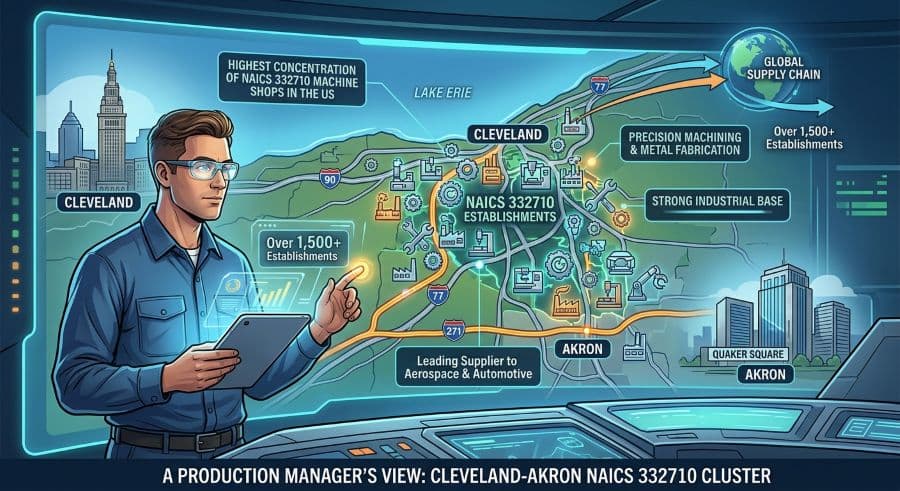
A region that succeeded by not specializing
Most manufacturing regions have a single dominant customer. Detroit's tooling corridor lives and dies with auto release schedules. Houston's machining base rises and falls with rig counts. The Cleveland-Akron corridor doesn't work that way, and that is exactly what makes it interesting — and exactly what makes scheduling here harder than the textbooks admit.
A typical contract shop in Northeast Ohio is running parts for an automotive tier supplier, an aerospace bracket program, a polymer-processing OEM, and a defense subcontract in the same week, on the same machines, against four completely different planning rhythms. The diversification that protected these shops through fifty years of regional boom and bust is the same thing that turns their production schedule into a daily negotiation.
This is a production manager's view of the regional economy: who's here, what they make, and why the structure of the market shows up on the shop floor as a scheduling problem. If you run a shop in the corridor — or you're selling into it — the mix is the story.
Machine shops in Cleveland, Ohio anchor a dense, broad base
Start with the national picture. The U.S. has roughly 16,627 establishments classified under NAICS 332710, the Census code for machine shops (U.S. Census Bureau, County Business Patterns). Ohio sits in the top tier of states for that count, alongside California, Texas, Michigan, Pennsylvania, and Illinois — and it gets there with a fraction of California's or Texas's overall population, which tells you how concentrated the manufacturing base actually is. A large share of that Ohio total is machine shops in Cleveland, Ohio and the surrounding corridor.
Zoom into the corridor and the concentration tightens further. The 18-county Northeast Ohio region tracked by Team NEO and MAGNET supports a manufacturing sector reported at roughly $46 billion in output, more than 248,000 workers, and about 7,700 facilities (MAGNET–Team NEO, Make It Better regional manufacturing report, 2021). Statewide, manufacturing runs to 16,287 establishments and 682,275 jobs at an average weekly wage of $1,471 (Ohio LMI / Quarterly Census of Employment and Wages, 2024 annual averages). Cleveland and Akron sit at the center of that base.
What matters for scheduling isn't just the headcount — it's that the density is horizontal, not vertical. The corridor didn't grow one industry deep. It grew across primary metals, fabricated metal, machinery, polymers, and a long tail of contract machining that feeds all of them. That horizontal spread is the regional advantage and the regional scheduling tax in one fact.
Cleveland and Akron are not the same shop town
It's tempting to treat the corridor as one market, but the two anchors grew from different roots, and the difference still shapes the work. Cleveland built its base on steel, heavy fabrication, and the auto and aerospace supply chains that grew up around the lakefront and the Cuyahoga industrial flats. Its contract machining tends toward precision metal work feeding those sectors — the kind of Cleveland precision machining that supplies brackets, housings, and close-tolerance components to OEMs and tier suppliers.
Akron came up as the rubber capital, and that polymer DNA never left. Even after the tire majors consolidated, the surrounding ecosystem of polymer processing, compounding, and the tooling that serves it stayed dense. Akron manufacturing today leans toward the mold, die, and fixture work that polymer and plastics processors depend on, plus a deep bench of specialty materials expertise you don't find in most metal-fab regions.
For a shop owner, that split is a sourcing reality. The corridor gives you access to both a metals-and-machining labor pool and a polymers-and-tooling one within a forty-five-minute drive, which is part of why diversified Northeast Ohio job shops can credibly serve four downstream industries at once. It's also why no single regional playbook fits every shop — a Cleveland precision house and an Akron tooling shop are solving related but distinctly weighted versions of the same scheduling problem.
Four downstream industries, four different clocks
Diversification sounds like risk management, and it is. But every downstream industry the corridor serves brings its own planning cadence, and those cadences don't line up.
Automotive tier suppliers run on tight, EDI-driven release schedules with short fuses and brutal penalties for a missed window. Aerospace work runs long, with heavy documentation, first-article inspection, and lot traceability that makes a rushed reschedule expensive. Polymer-processing customers — a genuine Northeast Ohio specialty rooted in the region's rubber and plastics history — bring tooling, fixturing, and replacement-part work that lands unpredictably. Defense subcontracts add their own paperwork, lead times, and priority overrides that can jump the queue with little notice.
A shop serving one of these has a hard scheduling problem. A shop serving all four has a different problem entirely: reconciling four conflicting definitions of "urgent" on a shared set of machines. The automotive release that has to ship Thursday and the aerospace lot that can't be rushed without re-running inspection are both real, both legitimate, and both want the same three-axis mill on Wednesday afternoon.
This is the defining characteristic of mixed-portfolio shops, and it's why the standard advice to "just sequence by due date" falls apart here. Due date is one input. Setup similarity, material availability, inspection requirements, and customer penalty exposure are all competing inputs, and they weight differently depending on which of the four customers you're talking to. We cover how shops actually reconcile that in the guide to mixed-portfolio scheduling.
The tooling and mold layer underneath everything
Sitting underneath the corridor's part-production work is a tooling, mold, and die layer that quietly sets the pace for the rest. Polymer processors need molds. Auto suppliers need dies and fixtures. Aerospace needs custom workholding. Much of that tooling work is long-cycle — eight to fourteen weeks is normal — and it shares machines and skilled operators with the short-cycle production jobs running alongside it.
That collision is the hardest part of scheduling a Northeast Ohio shop. A long tooling program parked on a machine for two weeks isn't wrong; it's the work. But it has to coexist with the automotive release that turns around in three days. Slot them poorly and the long job starves the short ones, or the short ones constantly bump the long one and its delivery slips a month from a hundred small interruptions. Shops in the corridor that also do mold and die work face the same structural tension we describe for the Chicago-Rockford mold and die corridor — different geography, same problem of long programs and short jobs fighting for the same spindle.
The shops that handle this well aren't the ones with the most machines. They're the ones who can see the long jobs and the short jobs on the same board and make the trade deliberately instead of by whoever shouts loudest at 4 PM.
The labor math makes the scheduling harder
You can't talk about scheduling in this corridor without talking about who's running the machines. The regional workforce skews heavily toward production and manufacturing roles, and the pipeline is under pressure. Team NEO's 2025 work documents 92 completed business investments expected to generate about 2,953 new jobs and $188 million in annual payroll across the region (Team NEO, 2025 Annual Performance & Impact Report). That's real momentum on attraction — but it lands on top of an existing shortage, not an empty field.
MAGNET's 2025 manufacturing survey found regional firms largely holding headcount steady rather than expanding, citing higher material costs, tariff uncertainty, and persistent staffing gaps (reported via Crain's Cleveland Business, April 2026). Translated to the shop floor: the experienced operators who used to absorb scheduling chaos through sheer institutional memory are retiring, and the shops replacing them are doing it slowly and at higher cost.
That changes what a schedule is for. When you had a thirty-year setup man who knew which jobs to nest and which to keep apart, the schedule could be loose — he filled the gaps. When that knowledge walks out the door, the schedule has to carry the information that used to live in his head. A shop that ran fine on a whiteboard for two decades can find itself unable to keep the same promises with a younger crew, not because the crew is worse, but because the institutional buffer is gone.
Why the standard scheduling tools fit this region badly
Most Cleveland and Akron shops schedule one of three ways: a spreadsheet, a whiteboard, or a scheduling module inside an ERP system bought for accounting and job costing. Most machine shops in Cleveland, Ohio land on one of those three by default, not by choice — and each one breaks against the corridor's specific structure.
Spreadsheet-based scheduling assumes a stable list you can sort. The mixed-portfolio reality is a list that re-sorts itself every time a customer changes a date, and a spreadsheet has no way to show you what a change costs downstream — it just lets you overwrite a cell and find out later. Whiteboards make the current state visible but lose it the moment you erase, which means no history, no what-if, and no way to see a conflict before it reaches the floor.
ERP-based scheduling has the opposite problem. Enterprise systems are built around the assumption that planning is a settled, top-down activity, and they're heavy to change once a release is locked. That's a poor fit for a shop reconciling four customers' definitions of urgent in real time. The scheduling module in an ERP suite is usually a secondary feature bolted onto a system bought for other reasons, and it shows.
None of this means these shops are behind. Most have good reasons for the tools they use — the spreadsheet is free, the whiteboard is honest, and the ERP was bought to solve a real costing problem. The gap isn't competence. It's that the corridor's diversified, mixed-cadence reality needs scheduling that's visual, fast to re-sequence, and built to show the cost of a change before you commit to it. That's the specific problem a purpose-built production scheduling approach for job shops is meant to solve, and it's why a drag-and-drop view of the whole shop tends to land better here than another module inside another system.
What this means if you run a shop in the corridor
If your shop serves more than one downstream industry — and in Northeast Ohio, most do — your scheduling problem isn't a sequencing problem. It's a reconciliation problem. The question isn't "what runs next," it's "whose definition of urgent wins this hour, and what does that decision cost the other three customers."
The shops that thrive in this market treat that reconciliation as a daily, deliberate act instead of a 4 PM scramble. They can see every job on every machine, they can move a job and immediately see what else moves with it, and they keep a record of the trades they made so the next conflict isn't argued from memory.
If that pattern sounds like your shop, the place to start is getting the whole mix onto one visible board. We dig into how diversified Northeast Ohio shops handle exactly this in our Cleveland mixed-portfolio breakdown. If you'd rather see your own jobs on a visual schedule instead of reading about it, you can start a free trial of Visual Machine Scheduler — no credit card, 14 days — or browse the planning tools and templates in the store if you want to start with something lighter than software. Either way, the first move is the same: make the mix visible before it makes the decision for you.
Ready to go beyond the guide?
Most shops are on a live Gantt board within 60 minutes of sign-up, with their existing job list imported from Excel.
Get shop floor scheduling guides in your inbox
Practical articles for production managers — no spam, unsubscribe anytime.
Related articles
Scheduling an API-Certified Machining Operation: Traceability and Documentation Considerations
API-certified machining isn't just a quality label. It's a documentation chain that has to follow every part from raw ma…
Project-Based Scheduling for Oil & Gas Machine Shops: When the Rig Count Drives Demand
Oil & gas machining doesn't run on a manufacturing-belt rhythm. It runs on rig counts, capital project gates, and well c…
Long-Cycle Job Scheduling for Mold & Die Shops: The 12-Week Build Problem
Mold and die shops are the longest-cycle work in machining. A single program can occupy a machining center for 6–14 week…