Houston's Energy Corridor Machine Shops: Inside the Oil & Gas Supply Base
Houston is the only US machine shop economy where the dominant rhythm isn't OEM release schedules but oilfield service activity. Scheduling here means tracking rig counts and pad delivery dates.
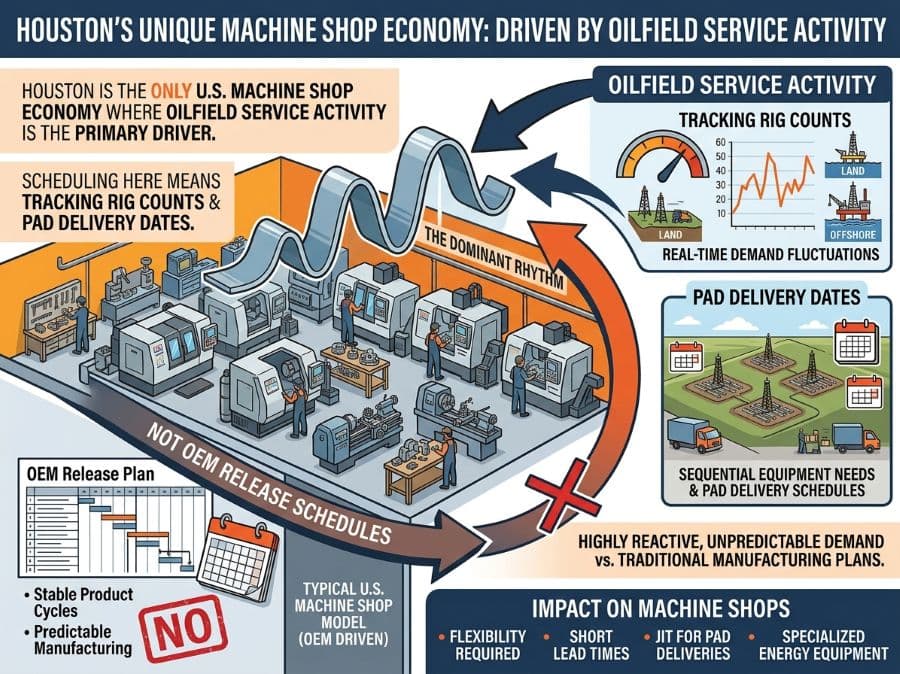
When the demand signal is a rig, not a release calendar
When a rig goes down in the Permian or a completion crew pulls a frac date forward, the pressure lands somewhere specific: a machine shop in Houston that now has to get a downhole tool component to the pad before the crew is ready for it, not three days after.
That phone call — not a quarterly OEM release schedule — sets the rhythm for most machine shops in Houston, Texas. It's the structural fact that separates the Houston supply base from almost every other concentration of metalworking in North America. In the Manufacturing Belt, a job shop's calendar is anchored to a customer's production line: the part is due when the line consumes it, and the line runs on a schedule you can see weeks out. In Houston, the calendar is anchored to field activity you don't control and often can't forecast past the current quarter.
This guide breaks down how the Houston oil and gas machining economy is built, what it actually makes, and why scheduling a shop here is a different discipline than scheduling one in the Midwest.
Why machine shops in Houston, Texas don't run on OEM calendars
Across the United States there are 16,627 machine shops (US Census Bureau, County Business Patterns, NAICS 332710). The vast majority of them sit downstream of an original equipment manufacturer — an automotive tier supplier, an ag-equipment plant, an aerospace prime. Their demand is lumpy but legible. You know the program, you know the takt, and you can plan capacity against a release schedule that someone else publishes.
Houston is the exception. The dominant customer here isn't an OEM running a line; it's an oilfield service company responding to field conditions. Demand is driven by drilling and completion activity, which moves with commodity prices, rig deployment, and the pace of work in the Permian, Eagle Ford, and the Gulf. The practical demand signal a Houston shop watches isn't a customer's MRP output — it's the weekly rig count and the pad delivery dates that follow from it.
That changes the planning problem in three concrete ways:
- Demand is project-shaped, not program-shaped. Work arrives as discrete jobs tied to specific wells, tools, or repairs — not as a recurring monthly quantity you can level-load.
- Lead times compress under field pressure. A part needed to get a rig turning again is worth more on Tuesday than on Friday, and customers will pay expedite premiums to compress the schedule.
- The backlog is cyclical. When activity is high, the shop is capacity-constrained and turning away work. When prices fall, the same shop is hunting for jobs. Texas energy machining lives on this boom-and-bust amplitude more than any other regional supply base.
A scheduling method built for steady program work — level loading, fixed weekly buckets, utilization targets — fights the actual shape of the demand. The shops that run well here plan around commitments and due dates first, and treat capacity as the thing they flex against those commitments.
The work: downhole tools, pressure vessels, and API-grade parts
Houston oil and gas machining isn't one product category. It's a stack of them, and each one carries its own scheduling weight.
Downhole tools. This is the signature work of the corridor — bodies, mandrels, subs, and components for the tools that go thousands of feet into a well. Downhole tools machining in Houston means tight tolerances on large-diameter, deep-bore parts, often in exotic or high-strength alloys, with material traceability from bar stock to finished part. These jobs are long-cycle and unforgiving: a scrapped part late in the process isn't just lost material, it's a lost slot in a schedule that was already promised to a field date.
Pressure-rated components. Pressure vessel machining and the broader category of pressure-containing parts — valve bodies, wellhead and Christmas tree components, flanges, and connectors — carry inspection and documentation requirements that sit directly on the critical path. The machining is the easy part to estimate. The hold points, witnessed inspections, and paperwork are what actually determine when the job ships.
Repair and reman. A large share of shop demand is repair, refurbishment, and remanufacturing of field-returned equipment. This work is the hardest to schedule because you can't fully scope it until the part is on the bench. Estimated hours and actual hours diverge constantly, and a shop that schedules reman jobs as if they were known quantities will miss dates all day.
The common thread is that none of this work is anonymous. Every job is attached to a well, a tool string, or a field deadline, and the value of the part is tied to arriving on time far more than to the marginal cost of the machine-hour that made it.
Project-based scheduling beats utilization-based scheduling here
Most production-scheduling advice tells you to chase machine utilization. For a Houston shop, that's the wrong north star.
Utilization optimization assumes that keeping spindles turning is the goal, because idle capacity is the main waste. That logic holds in a high-volume program shop. It breaks in a project-based oilfield supplier, where the expensive failure isn't an idle machine — it's a job that finishes the day after the pad needed it. A shop can run at 90% utilization and still bleed money if the wrong 90% got prioritized and the field-critical job slipped.
The number that matters here is schedule reliability: did the committed jobs hit their due dates? That reframes scheduling as a commitment-management problem rather than a capacity-filling one. The questions change from "how do I keep every machine busy" to "which jobs are field-critical this week, what's the realistic finish date for each, and where do they collide for the same machine, fixture, or inspector?"
The cost of getting this wrong is quantifiable. The hidden cost of manual, reactive scheduling runs 5–10% of revenue in a typical job shop (Qlector 2025) — and in a project-based shop, that loss concentrates in missed and expedited due dates rather than in idle capacity, because the schedule is the product promise. Each scheduling conflict that reaches the floor — two committed jobs landing on the same machine in the same window — costs $250–$1,000 in restart, resequencing, and lost capacity (Product Brief §2), and that's before counting the customer relationship cost of a missed field date.
This is the core argument of project-based scheduling for oil and gas machining, and it's the lens the rest of this guide assumes. If you want the broader foundations first, the complete guide to production scheduling for job shops covers the general method that this regional case specializes.
What API certification does to your schedule
A large share of Houston oil and gas work runs under American Petroleum Institute (API) specifications — API Spec Q1 for quality management, and product specs such as API 6A for wellhead equipment or API 7-1 for drilling components, among others. Certification is a market-access requirement: many service companies won't buy from a shop that doesn't hold the relevant monogram.
What's less obvious to a shop coming from non-certified work is how much certification lands on the schedule rather than on the machines. Certified work brings documented traceability, defined inspection and hold points, qualification records, and a paper trail that has to travel with the part. Each of those is a scheduling constraint, not just a quality task:
- Hold points stop the job. A witnessed inspection or material verification means the part waits — sometimes for a person, sometimes for a document — before it can advance. That wait is real schedule time that a machine-centric plan tends to ignore.
- Inspection is a shared, constrained resource. A single CMM, a single inspector, or a single source-inspection slot can become the bottleneck for the whole shop even when every spindle is free.
- Documentation gates the ship date. The part can be physically complete and still unshippable until the cert package is closed out.
The scheduling implication is that certified jobs have to be planned as multi-resource sequences — machining plus inspection plus documentation — not as machine-time alone. The deeper treatment of how this reshapes a plan lives in scheduling considerations for API-certified machining.
One boundary worth stating plainly: the specifics of what any given certification requires of your shop are determined by the relevant standard and your auditor or certifying body, not by a blog post. This guide describes the scheduling effects of certified work; confirm the actual requirements with API and your registrar.
Where the Houston schedule actually breaks
The failure mode in a Houston machine shop is rarely a lack of work or a lack of capability. It's the collision between committed jobs and the rush order that walks in because a rig is down.
The expedite request is the defining stress of the corridor. A field-critical job arrives with a delivery date measured in hours, and it has to be inserted into a schedule that was already full of jobs with their own promised dates. Insert it badly and you don't lose one date — you cascade. The expedited job bumps two others, which bump the jobs behind them, and by Friday the shop has missed three commitments to save one.
This is where reactive scheduling gets expensive. Unplanned, reactive disruption runs about 35% more expensive than planned work (Arda Cards 2026), and an oilfield supplier absorbs more of these disruptions than almost any other kind of shop because the disruptions are the business. The shops that survive boom-and-bust without burning customer trust aren't the ones that never get expedite calls. They're the ones that can see, in minutes, what an insertion actually does to every downstream commitment — which dates hold, which slip, and which customer needs a phone call before the date is blown rather than after.
That visibility is the thing a whiteboard and a spreadsheet stop providing somewhere around 15–20 concurrent jobs. Below that, the schedule fits in one person's head. Above it, the interactions between jobs, machines, inspection, and field dates exceed what any human can hold, and the shop starts managing by firefight.
The Texas energy machining advantage — and its fragility
Houston's concentration is a genuine advantage. The density of oilfield service customers, specialized suppliers, heat-treat and coating houses, and a trained workforce — supported by regional technical-training pipelines — means a shop can build deep capability in a narrow, high-value niche and stay busy through the up-cycle.
The fragility is the flip side. A shop that's tuned entirely to high activity is exposed when prices fall and rig counts drop, and the same specialization that's an asset in a boom becomes a liability when the field-specific work dries up. The Houston economy rewards shops that can ride the amplitude — scaling commitments up fast when activity returns, and protecting margin and customer relationships when it contracts.
Contrast this with a region like the Midwest mold-and-die corridor, where demand tracks consumer and industrial product cycles rather than commodity prices. A mold and die shop in the Chicago–Rockford belt runs on a different clock — longer programs, steadier demand, and a scheduling problem shaped more by tooling lead times than by field deadlines. Neither economy is easier. They're just governed by different signals, and a scheduling method that ignores which signal you're actually serving will misfire in both.
Scheduling a shop that runs on field time
The thing that makes machine shops in Houston, Texas distinctive is also what makes them hard to schedule: demand arrives as discrete, deadline-bound projects tied to field activity you don't control, under documentation requirements that sit on the critical path, with expedite pressure that can cascade through an entire week's commitments. Utilization-first scheduling, designed for steady program work, fights all of that.
The shops that run well here have made the same shift: they manage commitments and due dates first, treat capacity as the thing they flex, and keep the whole schedule visible enough to see what a rush order really costs before they accept it.
If you're sizing up that shift, the project-based scheduling guide for oil and gas machining is the right next read, and the downloadable scheduling tools and templates in the store give you something to start with before committing to software. We build scheduling software for shops exactly like these — drag-and-drop, due-date-first, built for the way a job shop actually runs. If you'd rather see it against your own jobs than read about it, start a free 14-day trial — no credit card required.
Ready to go beyond the guide?
Most shops are on a live Gantt board within 60 minutes of sign-up, with their existing job list imported from Excel.
Get shop floor scheduling guides in your inbox
Practical articles for production managers — no spam, unsubscribe anytime.
Related articles
Scheduling an API-Certified Machining Operation: Traceability and Documentation Considerations
API-certified machining isn't just a quality label. It's a documentation chain that has to follow every part from raw ma…
Project-Based Scheduling for Oil & Gas Machine Shops: When the Rig Count Drives Demand
Oil & gas machining doesn't run on a manufacturing-belt rhythm. It runs on rig counts, capital project gates, and well c…
Long-Cycle Job Scheduling for Mold & Die Shops: The 12-Week Build Problem
Mold and die shops are the longest-cycle work in machining. A single program can occupy a machining center for 6–14 week…