Running a Mixed-Portfolio Job Shop in Cleveland-Akron: When You Serve Five Industries at Once
The Cleveland job shop that serves only auto is rare. The typical shop runs auto Monday, aerospace Tuesday, polymer molds Wednesday, defense Thursday. Scheduling that takes a different discipline.
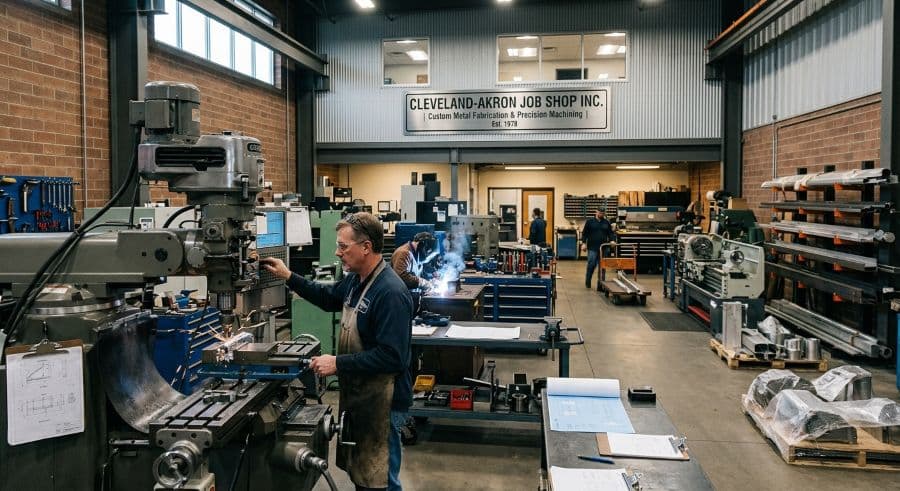
The shop that runs one industry is the exception, not the model
Walk through a contract machining shop somewhere between Cleveland and Akron on a Wednesday and look at what's actually clamped to the tables. There's a fixture for an automotive tier-two supplier that needs full lot traceability. Next to it, an aerospace bracket with a first-article inspection gate before anything ships. Across the aisle, a mold component for a polymer processor who measures lead time in days, not weeks. And somewhere in the queue sits a defense job with more paperwork than part.
That is not a shop that lost its focus. That is the typical Northeast Ohio job shop, and the diversification is deliberate. Auto pays the bills but punishes you on price. Aerospace and defense pay better but gate you behind certification and inspection. Polymer and medical work fills the white space between the long runs. Serving five downstream industries at once is how a diversified shop in this region survives a soft quarter in any one of them.
The problem is that almost every piece of scheduling advice you'll read assumes you run one kind of work. A mixed-portfolio shop doesn't. This is a guide to scheduling when every customer wants something different: why the usual advice breaks, what each vertical actually demands of your board, and how to run one schedule that respects all of them.
Why the diversified Cleveland-Akron shop is the rule
Northeast Ohio didn't end up diversified by accident. The Cleveland-Akron corridor grew a machining base around automotive, then layered on aerospace, polymers and rubber, defense, and medical device work as those industries clustered in the region. A shop that set up to serve only one of them would be exposed every time that sector cooled. So the regional pattern is the generalist: a shop with the equipment and certifications to take work from several downstream industries, sequencing them across the same machines.
That diversification is a competitive strength on the sales side and a scheduling burden on the floor. Nationally, machine shops (NAICS 332710) number 16,627 establishments (Census County Business Patterns), and the ones that hold up across cycles tend to be the ones that learned to serve more than one master. The broader regional machining landscape is worth understanding on its own terms; if you want the wider view, see the rundown of the Cleveland-Akron machine shop scene.
What follows assumes you've already made the strategic choice to diversify. The question is how to schedule it without the wheels coming off.
Each industry brings its own scheduling clock
The mistake is treating a job as a job. In a mixed shop, the industry behind the job dictates how it has to move through your schedule. A part isn't just a setup and a cycle time; it carries the rhythm, due-date discipline, and documentation burden of the customer who ordered it.
Here's the rough shape of what each vertical tends to impose on the board:
| Industry | Due-date discipline | Documentation / cert pressure | Typical lot size | Changeover sensitivity |
|---|---|---|---|---|
| Automotive | High — release schedules, line-down penalties | Lot traceability, IATF-driven controls | Medium to high volume | Moderate; families repeat |
| Aerospace / Defense | High — inspection-gated milestones | First-article inspection, AS9100 / ITAR controls | Low volume, high mix | High; frequent unique setups |
| Polymer / plastics molds | Very high — short turnaround expected | Lighter, customer-specific | Low, often one-off | High; rarely repeats |
| Medical device | High — sequenced to validation needs | Traceability, ISO 13485 controls | Low to medium | Moderate to high |
| General / industrial | Variable — negotiable on price | Light | Mixed | Mixed |
A few clarifications on what those acronyms mean for the schedule. IATF 16949 is the automotive quality standard; AS9100 is the aerospace equivalent; ISO 13485 governs medical devices; ITAR is the U.S. export-control regime that touches a lot of defense work. They matter to scheduling because they push traceability, inspection sequencing, and controlled-access requirements into the routing — a certified part can't skip its inspection gate to make a ship date. The specific obligations for your certifications should be confirmed with your auditor or the certifying body; treat the table above as the scheduling shape, not a compliance instruction.
The practical takeaway: a shop that runs auto and aerospace on the same five-axis machines is constantly trading a high-volume repeating family against a low-volume gated one-off. That trade is the whole job. Managing it well is the core of multi-customer job shop scheduling.
The constraint isn't your machines — it's your changeovers and your shared bottlenecks
Most utilization advice tells you to keep machines busy. For a diversified shop, raw machine-busy percentage is the wrong target, because your real constraint is rarely the spindle hours. It's the setup time you burn switching between industries, and the one or two shared resources every job has to pass through.
Think about what happens when you sequence a mixed schedule by customer arrival order. Auto family, then a one-off aerospace setup, then a polymer mold, then back to a different auto family. You've torn down and rebuilt the fixture four times when a smarter sequence would have grouped the two auto families and cut a changeover entirely. The machine was "utilized" the whole time. You still lost an hour of capacity to avoidable setup.
The shared bottleneck makes this worse. In a lot of Cleveland-area shops the constraint is a single inspection cell, a heat-treat hand-off, or one machine with the only fixture that runs the gated aerospace work. Every industry's jobs funnel through it. Sequence that resource by who shouted loudest and you'll watch a low-volume, inspection-gated defense part get bumped behind three auto releases, then miss its milestone by a day.
The goal isn't to keep every machine busy. It's to keep the constraint fed with the right job in the right order, and to stop paying for changeovers you didn't have to make.
That reframing is the difference between a shop that runs at the mercy of its inbox and one that runs to a plan. It's also why scheduling a mixed-portfolio shop is a genuinely different discipline than scheduling a specialist.
Why spreadsheets and ERP modules break in a mixed shop
A whiteboard or a spreadsheet works fine when you run one kind of work with predictable families. It stops working the moment five industries with five different clocks share the same machines.
Spreadsheet-based scheduling has no concept of a changeover family or a shared constraint. It's a list of jobs and dates. When an aerospace inspection slips, nothing recalculates — you find out at 4 PM that three downstream jobs are now wrong, and you re-key the whole sheet by hand. The hidden cost of that manual approach is real and measurable: manual scheduling inefficiency runs an estimated 5–10% of revenue in a typical job shop (Qlector 2025). For a $2M shop, that's $128,000–$276,000 a year disappearing into rework, expedites, and capacity you scheduled but never actually used.
ERP-based scheduling has the opposite problem. The scheduling module inside a general ERP was usually built around inventory and order flow, not the finite-capacity reality of a shop juggling gated aerospace work against high-volume auto releases. It tells you what is due, not whether the floor can actually hit it given the setups and the one inspection cell everyone shares. Production managers in diversified shops end up running the ERP for the front office and a separate spreadsheet for the actual schedule — which means the schedule the floor runs and the schedule the system believes are two different documents.
Neither tool fails because it's bad software. They fail because a mixed-portfolio shop is a finite-capacity sequencing problem, and they were built for something else.
Scheduling discipline for the five-industry shop
You don't need to abandon diversification. You need a method that holds when the work doesn't match. A few principles that hold up on a mixed floor:
- Sequence by constraint and changeover, not by customer. Group jobs that share a setup family. Protect the order of work through your bottleneck. Customer arrival order is the worst possible sort key for a mixed shop.
- Protect the gated work. Inspection-gated aerospace, defense, and medical jobs can't be compressed at the end the way a price-sensitive industrial run sometimes can. Give them their milestones early and schedule backward from the gate.
- Make the trade-off visible. When auto and aerospace compete for the same machine, you're making a margin-versus-volume decision every time. A schedule that surfaces that trade lets you make it on purpose instead of by accident.
- Reschedule fast, because you'll reschedule constantly. A diversified shop gets a customer change almost daily. The cost of a scheduling conflict that reaches the floor — a restart, a resequence, lost capacity — runs $250–$1,000 per incident (Product Brief §2). The shop that absorbs a change in two minutes loses far less than the shop that re-keys a spreadsheet for an hour.
- One board, not five. The whole point of diversification is that the work shares your machines. Your schedule has to share one view too, or you can't see the conflicts until they hit the floor.
This is where a visual, drag-and-drop schedule earns its keep. When every job on every machine sits on one board, color-coded by industry, you can see the auto-versus-aerospace trade, see the constraint, and see what a customer change does downstream — before you commit to it. Diversified machining regions face the same pattern elsewhere; the dynamics will look familiar if you've read about the Chicago-Rockford machining corridor, which runs a comparable multi-industry mix.
Run the diversification you built
Serving five industries at once is a strength. It's why a Cleveland-Akron shop can ride out a soft quarter in auto on the back of aerospace and medical work. But that strength only holds if your schedule can actually carry it — if you can sequence five clocks across shared machines without burning capacity on avoidable changeovers or letting a gated job miss its gate.
The shops that struggle aren't the ones with too many industries. They're the ones running a single-industry scheduling method against a multi-industry floor. Fix the method and the diversification becomes the moat it was supposed to be.
If you want to see your own mixed schedule on one board — every job, every machine, color-coded by customer, reschedulable in seconds — start a free trial of Visual Machine Scheduler. No credit card, 14-day trial, and you can load your real jobs in the first afternoon. If you'd rather start with a lighter-weight scheduling aid before committing to the full tool, browse the scheduling resources in the store and come back to the trial when you're ready to run the whole floor from one view.
Ready to go beyond the guide?
Most shops are on a live Gantt board within 60 minutes of sign-up, with their existing job list imported from Excel.
Get shop floor scheduling guides in your inbox
Practical articles for production managers — no spam, unsubscribe anytime.
Related articles
Scheduling an API-Certified Machining Operation: Traceability and Documentation Considerations
API-certified machining isn't just a quality label. It's a documentation chain that has to follow every part from raw ma…
Project-Based Scheduling for Oil & Gas Machine Shops: When the Rig Count Drives Demand
Oil & gas machining doesn't run on a manufacturing-belt rhythm. It runs on rig counts, capital project gates, and well c…
Long-Cycle Job Scheduling for Mold & Die Shops: The 12-Week Build Problem
Mold and die shops are the longest-cycle work in machining. A single program can occupy a machining center for 6–14 week…