Project-Based Scheduling in Houston Oil & Gas Machining: Riding the Rig Count
When the rig count climbs, Houston machine shops are slammed. When it drops, they idle. Scheduling here isn't about flow optimization — it's about elastic capacity.
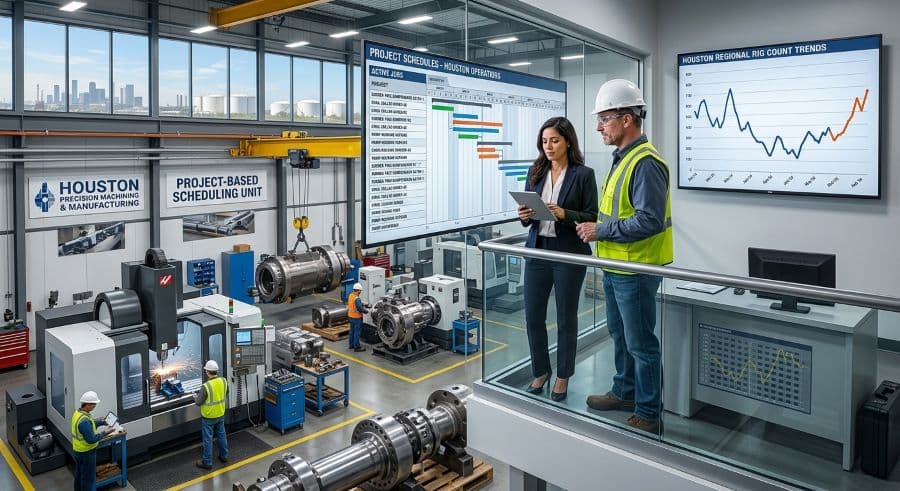
A Houston machine shop's order book is tied to a number published every Friday at noon
Every Friday at noon Central, Baker Hughes publishes the U.S. rig count. For a contract machine shop in Houston's energy corridor, that number is closer to a sales forecast than a piece of industry trivia. When rigs are turning, the orders follow — downhole tools, completion hardware, valve bodies, subs and crossovers, and the fishing tools nobody needs until a string parts two miles down. When rigs stack out, the phone goes quiet.
That is a fundamentally different scheduling world than the one most production scheduling advice is written for. The textbook job shop runs against a steady belt: an OEM release schedule, a forecast that moves a few points a quarter, a takt time you can level-load against. Houston oilfield machining doesn't have a belt. It has a cycle, and the cycle is violent.
Here's how project-based oilfield machining flows differently from manufacturing-belt cadence — and what that means for how you actually schedule the floor.
Why oilfield machining doesn't flow like the rest of manufacturing
Walk a Tier-2 automotive or aerospace supplier and you'll see scheduling built around predictability. Demand arrives on a release schedule weeks or months ahead. The scheduling problem is sequencing and efficiency: minimize changeovers, hold takt, keep work-in-process flat. A shop in a region like the Chicago and Rockford machining belt often lives in that world — repeat parts, named programs, demand you can largely see coming.
Oilfield machining runs on a different clock. Demand is event-driven: a rig spuds a well, a tool fails in the hole, an operator sanctions a new completion. And the volume of those events tracks one thing closely — drilling activity, which in turn tracks oil price.
The rig count makes the swing concrete. In late 2014 the U.S. count ran near 2,000 rigs. By mid-2016, after the price collapse, it had fallen to around 400. The 2020 demand shock drove it to roughly 250 — the lowest in a count that has run continuously since 1944. Since then it has settled into a 550-650 plateau, sitting around 558 as of late May 2026 (Baker Hughes rig count, accessed June 2026). That is close to an eight-fold range inside a single decade.
You cannot level-load against a forecast that moves eight-fold.
The demand reaches a machine shop through a cascade, and each link adds or removes work. Oil price moves first. Operators respond by sanctioning or shelving drilling programs. Rigs get contracted and start spudding wells. Each active rig pulls a stream of machined consumables and tools through its life — drilling, completion, then production — and each well that comes online adds to the installed base that eventually needs repair, workover, and replacement parts. A shop sits somewhere along that cascade depending on what it makes, but the headwater is always the same number on the Friday report. That is also why the count is worth reading in detail rather than as a single figure: the U.S. total is heavily oil-weighted today, with oil rigs making up the large majority of the roughly 558 total (Baker Hughes, accessed June 2026), and the bulk of that activity concentrated in oil basins that feed Texas demand. A shop tied to oilfield work watches the oil split and the Permian-region activity more than the headline total.
Reading demand before it hits the floor: oil gas machine shop scheduling in Houston
The useful thing about the rig count is that it's a leading indicator, and it leads your order book by a measurable margin. Drilling activity follows oil price with a lag of roughly four months (EIA) — operators sanction or shelve programs as prices move, and the steel doesn't start turning until the rigs are contracted and spudding. For a machine shop, that lag is a gift: the demand that will hit your floor next quarter is partly visible in the price and rig data on your screen today.
That changes oil gas machine shop scheduling in Houston from a reactive exercise into a forward one. When the count is climbing, you know the completion and downhole tool orders are coming before the purchase orders land. When it rolls over, you know the repair-and-spares tail will thin out within a quarter or two. Shops that watch the leading indicators staff and book capacity against the cycle they can see; shops that only watch their current backlog are always a quarter behind it.
None of this removes the volatility. It just means you don't have to be surprised by it.
In practice, the read is more useful when you break the count into its parts. The headline U.S. total tells you the macro direction. The oil-versus-gas split tells you which of your customers are likely to move first — a gas-weighted recovery and an oil-weighted recovery pull different product mixes through a shop. The basin-level detail tells you whether the activity is landing where your customers operate. A Houston shop serving oil-basin operators cares less that the national count ticked up and more that the oil rig count and the activity in its customers' basins are trending the same way. The point isn't to trade the data — it's to give your capacity plan a few months of lead time the backlog alone won't.
Elastic capacity is the core scheduling problem — not flow optimization
In a level-loaded plant, scheduling is an optimization problem: given steady demand, sequence the work to squeeze out the most throughput. In Houston oilfield machining, that's the wrong frame. The core problem isn't optimizing flow through fixed capacity. It's managing capacity that has to stretch and contract with the cycle.
In an up-cycle, the constraint is capacity you don't have. You're adding overtime, spinning up a second or third shift, pushing overflow to outside machining partners, and slotting rush downhole-tool orders between committed jobs. The question that decides whether you make money or make enemies is a simple one: can we actually take this on by the date the operator needs it? Answer yes when the floor is already full and you've bought a missed delivery to a customer who is drilling on your part.
In a down-cycle the constraint flips. Now you have machines and people and not enough work to cover them. The scheduling job becomes keeping utilization visible so idle capacity is a decision you're making on purpose — what to keep warm, what to cross-train, what to bid aggressively to fill — rather than a number you discover at month-end.
Across job shops generally, manual scheduling already drains an estimated 5-10% of revenue — $128,000 to $276,000 a year for a $2M shop (Qlector 2025). In a shop whose demand swings eight-fold, the cost of getting capacity decisions wrong is more acute, because there is no steady baseline to absorb the error.
Labor is the part of capacity that flexes slowest, which makes it the part scheduling has to respect most. Machines can be bought, rented, or subcontracted around. A qualified machinist who can hold tenths on a downhole tool in 4140 or Inconel cannot be hired in the two weeks between a rig-count uptick and the first rush order. In an up-cycle, the shops that win are the ones that staffed slightly ahead of the curve because they read it coming. In a down-cycle, the same constraint runs in reverse: the skilled people you lay off in a trough are the people you can't get back fast enough in the recovery, and competitors who held their crew through the dip take the first orders. A schedule that shows true per-shift capacity — not a theoretical machine-hour number that assumes a body in front of every spindle — is what keeps those decisions grounded.
Project-based jobs don't behave like repeat production
The other half of the problem is what the work itself looks like. A repeat-production shop schedules line items off a recurring bill of materials. Oilfield machining is closer to project-based scheduling for oil and gas work: much of the floor is one-off or small-batch, custom-geometry, long-cycle jobs — each with its own routing, fixturing, and material. Downhole tool scheduling in particular tends to run long: deep-hole operations, exotic alloys, tight tolerances, and steps that can't be rushed without scrapping expensive billet.
Then there are the field failures. A rig down in the field is burning tens of thousands of dollars a day, and the replacement part is a hot job the moment the call comes in. The entire schedule resequences around it. A shop that can slot an emergency job and see the downstream impact in minutes keeps the rest of its commitments intact; a shop that resequences by gut spends the next two days finding out what it broke. The hidden cost of a rush job is rarely the rush job itself — it's the three on-time deliveries it quietly pushed late because nobody could see the ripple until the dates had already slipped. Long-cycle work makes that worse: when a single job ties up a machine for days, there's less slack to absorb the next interruption, and the order in which jobs are sequenced stops being a convenience and becomes the thing that determines whether you hit your dates at all.
A lot of oilfield work also carries API certification. Machining to American Petroleum Institute (API) specifications adds fixed, non-machining steps to the routing — material traceability, documented inspection holds, and quality-record requirements — that have to be scheduled as real time on the job, not assumed away. What any given monogram or license requires is best confirmed with the certifying body or your auditor, but from a scheduling standpoint the lesson is constant: the overhead of API-certified work lives in the schedule whether or not you've planned for it.
What a scheduling system for this work actually needs to do
Put the cycle and the project flow together and the requirements get specific. A shop riding the rig count needs scheduling that can:
- Show live capacity across every machine, so "can we take this?" has a real answer during an up-cycle instead of an optimistic guess.
- Resequence fast when a field-failure rush job lands, and show what moving it does to everything downstream before you commit.
- Model multiple shifts per machine, because flexing from one shift to three is how you absorb an up-cycle, and the schedule has to reflect that capacity honestly.
- Keep utilization visible in a down-cycle, so idle time is a managed decision rather than a month-end surprise.
What it should not be is a heavy system built on the assumption that demand is steady. Spreadsheet-based scheduling collapses the first time a rush job forces a full resequence. ERP modules built around level-loaded, repeat production fight you when every job is a project and the volume triples in two quarters. Enterprise APS platforms can model the complexity but carry implementation timelines and price tags that only make sense at multi-plant scale. For a Houston shop in the 10-150 employee band, the fit is a scheduling tool light enough to flex with the cycle and visual enough to resequence on the fly.
Riding the cycle instead of getting ridden by it
Houston oilfield machining will always be cyclical — that's the nature of a business tied to drilling activity and oil price. The shops that do well across the cycle aren't the ones that somehow smooth the demand; that isn't on offer. They're the ones that read the leading indicators, plan capacity against the cycle they can see coming, and keep a live, honest view of the floor so they can say yes to the right jobs and resequence the rush work without blowing up everything else. That is what oil gas machine shop scheduling in Houston actually rewards: elastic capacity, managed deliberately.
If you want to pressure-test how your own floor flexes, our scheduling templates and tools are a low-commitment place to start mapping capacity against your machines and shifts. And if you'd rather see live capacity and drag-and-drop resequencing in your own shop, you can start a free 14-day trial — no credit card required. Either way, the next step is the same: get a forward view of your capacity before the next leg of the rig count decides it for you.
Ready to go beyond the guide?
Most shops are on a live Gantt board within 60 minutes of sign-up, with their existing job list imported from Excel.
Get shop floor scheduling guides in your inbox
Practical articles for production managers — no spam, unsubscribe anytime.
Related articles
Scheduling an API-Certified Machining Operation: Traceability and Documentation Considerations
API-certified machining isn't just a quality label. It's a documentation chain that has to follow every part from raw ma…
Project-Based Scheduling for Oil & Gas Machine Shops: When the Rig Count Drives Demand
Oil & gas machining doesn't run on a manufacturing-belt rhythm. It runs on rig counts, capital project gates, and well c…
Long-Cycle Job Scheduling for Mold & Die Shops: The 12-Week Build Problem
Mold and die shops are the longest-cycle work in machining. A single program can occupy a machining center for 6–14 week…