EDM and Wire EDM as the Hidden Bottleneck in Mold & Die Scheduling
EDM is slow, expensive, and unattended-friendly. That combination makes it the most-overlooked bottleneck in mold and die scheduling.
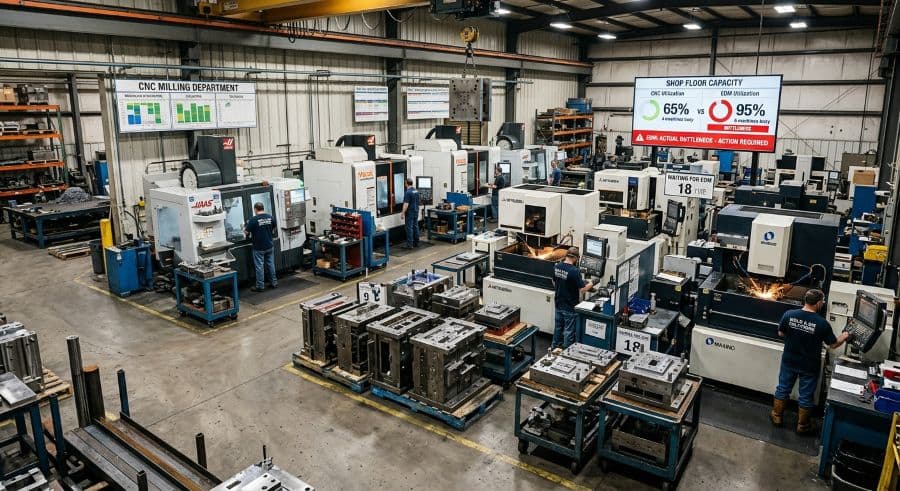
The new mill didn't fix the backlog
The loudest argument on a mold shop floor is usually about the mills. Lead times are slipping, so the owner prices out another vertical machining center, convinced more spindle hours will clear the backlog. Six months later the new mill is installed, its utilization looks healthy, and the molds still ship late.
The constraint was never the mills. It was the two EDM machines in the back corner, running overnight with nobody standing next to them.
In a lot of mold and die shops, electrical discharge machining is the quiet bottleneck. It is slow by design, expensive to feed, and easy to ignore precisely because it runs unattended. Those three traits are exactly what let a queue build up behind it without anyone noticing — until a customer calls about a date you can no longer keep. This article walks through how EDM and wire EDM turn into the scheduling bottleneck that sets your real shop capacity, how to surface that backlog before it surfaces you, and how to schedule around the constraint instead of pretending it isn't there.
Why EDM and wire EDM become a scheduling bottleneck
Start with the physics. EDM removes material by electrical erosion, not by cutting. A series of controlled sparks burns away metal one tiny pulse at a time, which is what makes it the right process for hardened tool steel, deep ribs, sharp internal corners, and the geometry a milling cutter physically cannot reach. It is also what makes it slow. A feature a mill would finish in minutes can take an EDM hours, and a complex cavity can take a full shift or more.
Slow alone wouldn't make it a bottleneck. The second factor does: EDM is unattended-friendly. Once a burn is set up and dialed in, the machine runs on its own — through lunch, through second shift, through the night with the lights off. Operationally that is a gift, because it turns idle calendar hours into productive ones. For scheduling, it is a trap. A mill that is backed up shows it: operators waiting, raw stock stacked at the door, a visible queue. An EDM that is backed up just hums along 24/7, and the queue behind it is invisible on a whiteboard or a spreadsheet that only tracks what is running right now.
The third factor is count. A shop might run ten or twelve CNC mills but only two wire EDMs and a single sinker. Every job that needs a burn funnels through that narrow gate. When you have one of a thing and everything has to pass through it, that thing decides your throughput — no matter how much capacity sits upstream of it.
Put those together — slow, invisible, and few — and you have a resource that quietly governs the whole shop while looking, from across the floor, like it is keeping up fine.
Wire EDM and sinker EDM create different scheduling problems
Treating "EDM" as one bucket is the first scheduling mistake, because wire EDM and sinker EDM behave nothing alike on the schedule.
Wire EDM cuts through-features and profiles by passing a charged wire through the workpiece, the way a band saw cuts a board, only far slower and far more precise. Its scheduling profile is relatively clean: a job is a block of machine-hours, those hours can run unattended, and the main scheduling job is sequencing the queue and protecting the overnight window. The catch is that wire EDM capacity is almost always underestimated because a single intricate detail can sit on the machine for a day or more, and one long job can stall five short ones behind it.
Sinker EDM — also called ram or cavity EDM — is the harder scheduling problem. It burns a shape into the workpiece using a shaped electrode, usually graphite or copper, that must itself be machined before the burn can start. That electrode dependency is the trap. The cavity burn cannot begin until the electrode exists, and machining the electrode competes for the exact CNC mills you thought were your bottleneck in the first place. So a single sinker job is really a two-stage chain: mill the electrode, then burn the cavity. Schedule those two stages as one undifferentiated block and you will double-book your mills. Schedule them as if they were independent and the sinker sits idle waiting on an electrode that nobody sequenced.
This is why sinker EDM scheduling fails quietly. The mill schedule looks full, the EDM looks busy, and yet the cavity work keeps slipping because the handoff between the two was never modeled as a dependency.
How to surface the EDM queue before it surfaces you
The fix starts with measurement, and the first rule is to stop counting jobs and start counting hours. A wire job that runs four hours and a wire job that runs forty are not interchangeable units of "one job." A queue of three jobs can be a half-day or a full week. Job count lies; backlog hours tell the truth. Measure the EDM backlog the same way you would measure machine-hours on any other constrained resource, and the picture changes immediately.
Take a thirty-person mold shop running ten CNC mills, two wire EDMs, and one sinker. The mill capacity is enormous on paper — call it eighty-plus machine-hours a day across the bank. But every cavity job has to clear the single sinker, and a deep cavity with a multi-electrode burn can occupy that one machine for two or three days straight. No amount of mill capacity relieves that. If four cavity jobs land in the same week, the math is unforgiving: one sinker, single-threaded, running burns that take days each, against four jobs that all promised the same delivery window. You can verify that ceiling yourself with nothing more than a calendar and the burn estimates — and it will sit well below what the mill schedule implies the shop can take on. That kind of long-cycle work is its own discipline; if a big share of your backlog is multi-day burns and long-cycle mold programs, the EDM ceiling is the number that actually governs your promise dates.
The second thing to surface is the electrode-make-then-burn dependency. For every sinker job in the queue, the schedule needs to show two linked tasks, not one: the electrode machining (on a mill) and the burn (on the sinker), with the burn unable to start until the electrode is done. When that link is explicit, the upstream mill schedule and the downstream EDM schedule stop lying to each other.
Scheduling against the constraint, not around it
Once you can see the EDM backlog in hours, the scheduling discipline is straightforward to describe and harder to hold to: treat the EDM as the constraint that sets the pace, and protect it.
Three habits do most of the work. First, sequence electrode machining upstream so a finished electrode is always waiting when the sinker frees up — never let the most expensive, slowest machine in the building sit idle because a $200 graphite electrode wasn't milled in time. Second, protect the unattended window deliberately. Front-load setups and electrode prep during the day so the long burns run through second shift and overnight, when the machine would otherwise be the most underused asset you own. A burn that finishes setup at 4:55 PM and runs until morning is free capacity; the same burn that doesn't get set up until the next morning is a day lost. Third, do not let a rush job jump the EDM queue without seeing what it bumps.
That last habit has a real cost attached. A scheduling conflict that reaches the floor — a bumped job, a burn interrupted to free the machine — costs $250–$1,000 per incident in machine restart, resequencing, and lost capacity (Product Brief §2). On an EDM, the lost capacity isn't only the incident itself; it's every unattended hour that overnight window would have produced and now won't. Resequencing the mill bank is recoverable. Resequencing the one machine everything funnels through is not.
This is classic constraint thinking applied to a specific machine: the bottleneck sets the drum, you keep it fed, you keep it running, and you stop optimizing the resources that were never the problem. None of it requires new equipment. It requires seeing the EDM as the governor it already is.
What a live capacity view does to the EDM problem
The reason most shops can't hold these habits isn't discipline — it's visibility. A whiteboard or a spreadsheet shows what is on each machine today. Neither shows the EDM backlog in hours, the electrode dependency linking a mill task to a burn, or the overnight window you are about to waste. You cannot schedule against a constraint you can't see.
A finite-capacity scheduling view changes that by modeling the EDM as its own resource with real hours, the same way it models every mill. The sinker shows up as a single lane with a measurable queue. The electrode-machining task shows up linked to its burn, so moving one moves the other and double-booking becomes visible the moment it happens. The overnight window is something you can deliberately fill rather than accidentally squander. This is the same capacity planning logic you'd apply anywhere in the shop, pointed at the resource that actually limits throughput.
When the EDM backlog is finally as legible as the mill backlog, the buy-another-mill reflex corrects itself. Maybe the answer is a second sinker. Maybe it's a dedicated electrode-machining cell so cavity burns stop competing with production milling. Maybe it's simply quoting honest dates the EDM can support instead of dates the mill schedule implies. In many mold shops the real ceiling isn't even the machine — it's the one experienced hand who can dial in a difficult burn, which is a capacity-planning problem of its own. Either way, surfacing the mold making EDM bottleneck turns it from the thing that silently breaks your promises into a number you can plan around. Shops in dense tooling regions feel this acutely; the scheduling pressure on a Chicago-Rockford mold and die shop lands squarely on the EDM department more often than on the mills.
Where this leaves your schedule
The bottleneck in a job shop moves. In general machining it sits on a mill or a turning center. In mold and die, more often than not, it sits on EDM — slow, expensive, running in the dark where nobody thinks to look. The shops that ship on time aren't the ones with the most EDM capacity. They're the ones that schedule the EDM as a constraint, link the electrode to the burn, and protect the unattended hours instead of giving them away.
The next step in your scheduling decision is small: measure your EDM backlog in hours for two weeks and compare it to your mill backlog. If the EDM number is the one driving your late jobs, you've found your real capacity ceiling — and you can start scheduling against it.
Want to see your EDM department as its own finite-capacity resource, with electrode machining linked to every burn? Start a free trial of Visual Machine Scheduler — no credit card required, 14-day trial. If you'd rather start with a worksheet, the downloadable planning tools in the store are a fine place to map your constraint by hand first.
Ready to go beyond the guide?
Most shops are on a live Gantt board within 60 minutes of sign-up, with their existing job list imported from Excel.
Get shop floor scheduling guides in your inbox
Practical articles for production managers — no spam, unsubscribe anytime.
Related articles
The True Cost of Unplanned Machine Downtime in a Job Shop (It's 35% More Than You Think)
Unplanned downtime doesn't just cost the hours the machine is stopped — it costs the resequencing labor, the emergency o…
OEE Calculation for Manufacturers: A Plain-English Guide with Examples
OEE is the most important machine metric most job shops never track. Availability × Performance × Quality = your real ma…
How to Calculate Machine Utilization Rate (With Free OEE Template)
Machine utilization rate is one of the most important metrics in a job shop, but most production managers have no reliab…