Communicating Schedule Changes: Telling Machinists and Customers What Actually Changed
The schedule changes. That's not the problem. The problem is everyone finding out from a different source at a different time and reacting to a different version.
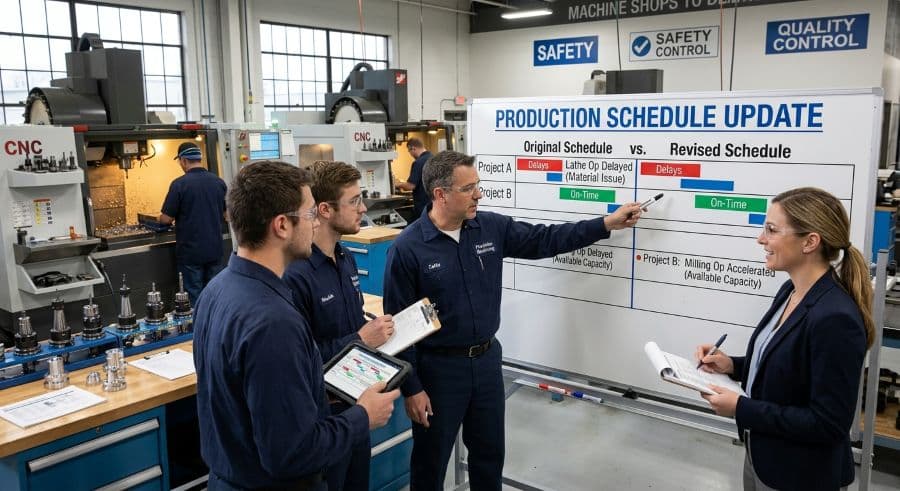
The schedule changing isn't the failure. The silent change is.
It's 2:30 on a Wednesday. A rush job lands, the material for it is already in-house, and the only machine that can run it is currently set up for a job that isn't due until Friday. So the schedule moves. The Friday job slides, the rush job jumps the queue, and the operator at that machine is about to start a setup that no longer matches what the shop needs from him.
That reschedule was the right call. A job shop that can't reshuffle around a hot order isn't agile, it's brittle. The schedule in a working shop changes every single day — broken tooling, late material, a machine that throws a fault, a customer who moves a date. None of that is the problem.
The problem is what happens in the next twenty minutes. The operator finds out from a sticky note. The customer service rep finds out from the operator two days later. The owner finds out when the Friday customer calls asking why their part is late. Three people, three sources, three different versions of the same schedule.
This is what communicating production schedule changes actually means, and most shops are bad at it not because they don't care but because they treat the change itself as the event and the communication as an afterthought. Here's how to flip that — how to tell the floor and the customer what changed, fast enough and clearly enough that everyone is reacting to the same version.
A change nobody heard about behaves exactly like a scheduling conflict
When an operator runs the wrong job because the schedule moved and the update never reached him, the cost isn't theoretical. A scheduling conflict that reaches the floor — a double-booked machine, a wrong setup, a job started out of sequence — runs $250 to $1,000 per incident in restart, resequencing, and lost capacity (Product Brief §2). A silent schedule change produces the identical failure through a different door. The schedule on paper was correct. The schedule in the operator's head was twelve hours stale.
That's the first thing to internalize: a scheduling conflict and a miscommunicated change are the same event with the same price tag. One comes from the plan being wrong. The other comes from the plan being right and nobody knowing it. You can fix the second one without buying anything — it's a discipline problem before it's a tooling problem.
The reason it stays unfixed is that the change feels handled the moment the scheduler makes it. The job got moved. Done. But moving the job and communicating the move are two separate actions, and shops routinely do the first and skip the second.
"It's in the system" is not communicating it
The most common dodge is the passive one. The scheduler updates the spreadsheet, drags the bar in the ERP, or rewrites the whiteboard, and considers the change communicated because the new state is now visible to anyone who looks.
Nobody looks. The operator is running a part. The CSR is on the phone. The second-shift lead won't be in for four hours. Posting a change to a surface people aren't actively watching is storage, not communication. A production schedule update that lives only in a system everyone has to remember to check will reach people late, in random order, and incompletely.
It gets worse when there's more than one surface. A shop running a whiteboard on the floor, a spreadsheet in the office, and an ERP module the owner trusts has three schedules, and the instant one changes without the other two, they disagree. Now the operator and the CSR aren't just reacting late — they're reading from different documents that say different things. Whoever shouts loudest or most recently wins, which is no way to run a floor.
The fix has two halves. One source of truth that everyone reads from, so there's no second version to drift. And an active push at the moment of the change — a deliberate "here's what just moved and here's what it means for you" — rather than trusting people to notice. The rest of this article is about what that push should actually contain, because the floor and the customer need almost opposite things from it.
Machinists and customers need opposite things
The single biggest mistake in schedule change communication is sending one message to both audiences. The operator and the customer care about completely different slices of the same event, at completely different levels of detail, on completely different clocks.
| What the machinist needs | What the customer needs | |
|---|---|---|
| Core question | What am I running next, and is my current setup still right? | Does my promised date still hold? |
| Detail level | High — job number, sequence, setup, material status | Low — the date, and a one-line why if it moved |
| Timing | Immediately, at the moment of the change | Proactively, before they ask, only if their date moves |
| Wrong move | Telling them at shift start about a change made yesterday | Explaining your internal shop chaos in detail |
A machinist who gets a customer-grade message ("we've had to adjust priorities this week") learns nothing actionable and keeps running the wrong setup. A customer who gets an operator-grade message (a wall of job numbers and machine reshuffles) hears a shop that's out of control and starts wondering whether to call a competitor. Same change, two audiences, two messages. Get the grain wrong and you create friction in both directions from a change that was handled correctly.
What to tell the floor: the change, the reason, the action
A floor-facing machinist schedule notification should answer three things, in this order, and nothing else:
- What changed — the specific job and the specific machine. "Job 4471 on the Mazak just moved ahead of 4438."
- Why, in one line — not the full backstory, just enough that it makes sense and doesn't feel arbitrary. "Rush order, material's already here."
- What you need them to do — the actual action. "Break down the current setup at the next safe stop and pull the fixture for 4471."
The reason matters more than schedulers think. Operators who understand why a job jumped cooperate; operators who get yanked around with no context start treating every reschedule as the office not knowing what it's doing. You're not asking permission and you're not writing an essay. One line of why buys you a floor that moves with you instead of grumbling against you.
Timing is the other half. Communicate the change at the moment you make it, not at the next shift start and not in a morning huddle for something that moved yesterday afternoon. The whole point is to overwrite the stale schedule in the operator's head before he acts on it. A change announced after the setup is half-done has already cost you the restart.
This gets sharpest across shift boundaries, where the person who made the change has usually gone home by the time the change matters. If your reschedules routinely happen on first shift and bite on second, the handoff is the leak, and tightening how schedule changes survive the shift handoff is where the recurring cost actually lives.
What to tell the customer: proactive beats reactive every time
Customers do not forgive late parts. They forgive moved dates told early far more readily than missed dates discovered late — those are two very different experiences, and the difference is entirely in the communication.
A customer who hears on Wednesday that their Friday part is now landing Monday, with a clear reason and a firm new commitment, files it as a shop that's on top of its work. The same customer who calls Friday afternoon to chase a part nobody warned them about files it as a shop that can't be trusted with a due date. The part was equally late in both cases. Only the on-time-delivery experience was different, and that's the thing the customer actually remembers at requote time.
So the rule for customer-facing communication is: if a change moves a committed date, the customer hears it from you before they think to ask, and they hear three things — the new date, a one-line reason, and the confidence behind the new number. "Your run shifted to Monday; we pulled a machine for a rush order ahead of yours and yours is set to start first thing Monday morning." That's it. No internal job numbers, no tour of your capacity problems, no apology spiral. A moved date stated with confidence reads as control. The same date stated apologetically reads as a shop that's surprised by its own schedule.
The trap is over-explaining. Operators-turned-owners want to be honest, so they narrate the whole reshuffle. The customer doesn't want the reshuffle. They want the date and a reason to believe it.
The single-source rule that makes both messages possible
Notice what both protocols quietly depend on: the scheduler, the operator, and the customer-facing person all working from the same current schedule. You cannot tell a customer a confident new date if you're not sure the floor will actually honor it. You cannot push a clean change to the floor if the office spreadsheet and the floor whiteboard already disagree.
That's why schedule change communication is, underneath, a single-source-of-truth problem. When the schedule lives in one place that everyone reads — and a change made there is visible to the floor and the office the instant it happens — the change communication stops being three separate manual relays and becomes one update that everyone is already looking at. The scheduler moves the job once. The operator's view updates. The customer-facing person sees the same new date the floor sees. There's no second version to drift out of sync, and no game of telephone to garble the reason.
This is also where the discipline compounds with everything else you measure. A shop that communicates changes cleanly stops bleeding the restart-and-resequence cost that quietly drags down machine utilization and OEE — because the most expensive "downtime" on a job shop floor is often a machine running the wrong job confidently.
What good looks like
Good schedule change communication isn't a meeting, a memo, or a new policy binder. It's a habit with three rules. Changes go to one schedule everyone reads, not three that drift apart. The floor gets the change, the one-line why, and the required action, the moment the change is made. The customer hears about any moved commitment from you first, with a confident new date and a short reason — never the internal mess behind it.
The schedule will keep changing. That's the job. The shops that handle it well aren't the ones with fewer changes — they're the ones where a change reaches the right people, in the right detail, fast enough to act on. Everyone reacting to the same version is the entire game.
If you want a starting point, our store has templates and checklists for floor and customer change-communication that you can adapt to how your shop already runs. And if the real fix is getting everyone onto one live schedule instead of reconciling three by hand, that's exactly what MachineScheduler is for — start a free 14-day trial, no credit card required, and see whether one shared schedule kills the telephone game in your shop.
Ready to go beyond the guide?
Most shops are on a live Gantt board within 60 minutes of sign-up, with their existing job list imported from Excel.
Get shop floor scheduling guides in your inbox
Practical articles for production managers — no spam, unsubscribe anytime.
Related articles
How to Handle Rush Orders Without Breaking Your Production Schedule
Every job shop gets rush orders. The ones that handle them without chaos have one thing in common: a live capacity view …
The 5 Production Scheduling KPIs Every Job Shop Should Track
Most job shops track OTD when a customer complains. The shops that consistently hit their due dates track five metrics w…
How to Improve On-Time Delivery in a Job Shop: A Practical 5-Step Guide
On-time delivery starts with knowing — before the customer calls — which jobs are at risk. Here's a 5-step guide to impr…