Scheduling a Mold & Die Shop in Chicago-Rockford: Long-Cycle Jobs in a Short-Window Region
Mold and die shops live in a strange scheduling space — 12-week new mold builds running alongside 3-day repair jobs. In Chicago-Rockford, that complexity is the default operating condition.
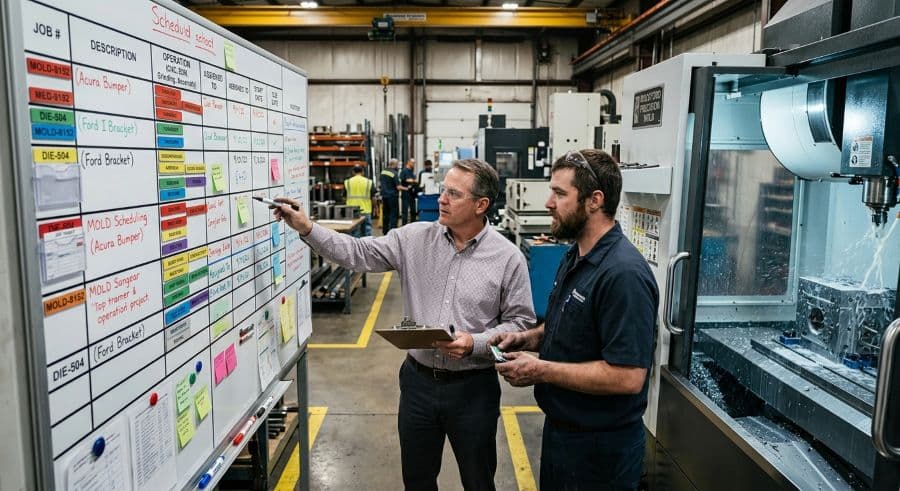
Two clocks run on the same machines
A new injection mold for a packaging customer takes 8 to 14 weeks to build. A repair on a cracked core that came off a press over the weekend has to ship in three days. Both jobs want the same wire EDM, the same high-speed CNC, and the same senior toolmaker — and the schedule has to keep both promises without dropping either.
That is the defining condition of a mold and die shop. Most production scheduling advice assumes jobs are roughly the same shape: a queue of parts that flow through work centers in hours or days. A mold shop runs two clocks at once. One ticks in weeks. The other ticks in hours. They share machines, they share people, and they constantly interrupt each other.
This article is about how that conflict behaves on the floor, why the Chicago-Rockford customer base makes it sharper than it is in most regions, and what to manage instead of raw machine hours when a single job can occupy a machine for three months.
Why a long-cycle build and a short-cycle repair fight for the same resources
A new mold is a project, not a part. It moves through design, roughing, heat treat, finishing, EDM, fitting, and tryout over several weeks, and the critical path runs through a handful of specific machines and one or two people who can actually do the fine work. Miss a step's timing early and the slip compounds for the rest of the build.
Repair and engineering-change work is the opposite. It arrives unplanned, it is small, and it is almost always urgent — a mold that is down is a customer's production line that is down. Three-day turnarounds are normal. One-day turnarounds happen.
The trouble is that the urgent small job and the slow big job draw from the same well. The wire EDM finishing a cavity insert for a 10-week build is also the only machine that can cut the worn detail on the emergency repair. The toolmaker fitting a new mold is the same person who has to diagnose the broken one. Every expedite spends capacity that was already committed to a long-cycle promise made weeks ago.
The bottleneck is rarely the building full of machines. It is the two or three pieces of equipment and the small handful of people who can do the precision work — the EDM operator, the senior mold maker, the inspector who signs off on tryout. A general-purpose CNC has backups. A toolmaker who can fit a class-A surface does not. When a repair lands, the shop isn't choosing between machines; it's choosing which of its scarce people stops what they were doing.
In shops that run mostly one type of work, you can schedule long-cycle builds by rule of thumb. A mold shop can't, because the two clocks are always negotiating for the same hour and the same hands.
The Chicago-Rockford customer mix makes the window tighter
Northern Illinois is one of the densest tooling regions in the country. The Rockford area carries decades of machine-tool and aerospace heritage, and the Chicago metro feeds a constant stream of packaging, consumer-goods, and food-and-beverage work that runs on injection molds. A single shop here often serves both worlds at once, which is part of the broader machine shop landscape across Chicago-Rockford.
That mix is what puts "short-window" in the same sentence as "long-cycle." Aerospace and tiered customers hold suppliers to narrow, audited delivery windows, and the Detroit-area automotive tier work that many Illinois shops also chase carries the same discipline. Packaging customers run high-volume lines where a down mold burns money by the hour, so their repair expectations are measured in days. The build cycles are long, but the customers behave as if they aren't.
For mold making scheduling in Chicago, the practical effect is that a shop can't absorb variability by quietly stretching lead times. The region's customer base doesn't grant that slack. The schedule has to hold long builds and fast repairs to tight windows at the same time, which is exactly the combination a whiteboard or a shared spreadsheet handles worst.
It also raises the stakes on the mix decision itself. A shop that wins a steady run of new-build work and a steady run of repair contracts has, in effect, signed up to keep two incompatible promises with one set of resources. Illinois tool and die scheduling is less about loading machines efficiently and more about deciding, week by week, how much of your scarce capacity you are willing to pre-commit to long builds versus hold in reserve for the repairs you know are coming but can't yet name.
The repair that jumps the queue costs more than the repair
When an emergency repair lands, someone makes a call: pull a machine off the long-cycle build to clear the repair. It feels free because no money changes hands. It isn't.
Every time a job is pulled and resequenced, the shop pays in machine restart, re-fixturing, lost setup, and the cost of a toolmaker switching context mid-task. A single scheduling conflict that reaches the floor runs $250 to $1,000 in restart, resequencing, and lost capacity (Product Brief 2026). On a mold shop floor where expedites are weekly, that is not a rounding error.
The second cost is invisible until tryout. Pulling capacity off a long-cycle build pushes its critical path right, and because each slip is small and the deadline is weeks away, nobody flinches. Do it four times across a 12-week build and the mold that was due Friday is now due the following Wednesday — discovered the week of tryout, when there is no room left to recover.
Picture the sequence. Week three, a repair pulls the EDM operator for a day; the build loses a day of cavity work. Week six, an engineering change on a different customer's mold takes the senior maker for an afternoon. Week nine, two more interruptions. None of them looked like a problem at the time, because each one cost a day against a deadline that was still a month out. They only become a problem when they stack — and by then the build has burned its float and the tryout date is immovable.
The expedite was never free. The bill just arrived late.
What "capacity" means when one job runs twelve weeks
Standard capacity math assumes jobs turn over fast enough that this week's load tells you something useful about next week's. A mold shop breaks that assumption. When one job occupies a critical machine for three months, capacity is not a weekly average — it is a calendar commitment that has to be reasoned about weeks ahead. That is the heart of capacity planning for a mold and die shop.
This is where spreadsheet scheduling quits. A grid that works for 20 jobs turning in a week becomes unreadable when half a dozen builds each span months, each with its own internal sequence, all overlapping on a shared set of machines. The moment you need to answer "if I take this repair today, which build slips and by how much," a static spreadsheet can't tell you. It has no model of the dependency.
For injection mold shop scheduling in Illinois, the unit of planning isn't the day — it's the build, laid out across weeks, with the critical machines and people visible against every other commitment on the floor. You have to see the whole calendar at once to know what an expedite actually costs before you say yes to it.
Consider a shop with three active builds and one EDM cell. Build A finishes its EDM work in week four, Build B needs the same cell in weeks five and six, Build C in weeks seven and eight. On paper the cell is fully booked but not overbooked. Now a repair lands in week five needing two days of EDM. There is no free slot. Either Build B slips, or the repair waits — and the repair can't wait, because a customer's press is down. The question the schedule has to answer is not "is the cell busy" but "which committed date do I break, and is it the cheapest one to break." A spreadsheet shows you the cell is full. It does not show you the consequence of the choice.
Stop scheduling by machine utilization
The instinct is to chase machine utilization and keep every spindle turning. The world-class Overall Equipment Effectiveness (OEE) benchmark sits at 85% (Nakajima/TPM literature), and it is a useful target for a high-volume production line.
It is the wrong primary metric for a mold shop. A two-shift, Monday-to-Friday operation runs roughly 80 of the 168 hours in a week, which structurally caps calendar utilization below 50% before a single job is scheduled — the math is the constraint, not the discipline. Pushing a senior toolmaker's machine to 95% "utilization" usually means you've eliminated the slack you need to absorb the next emergency repair, which guarantees the next expedite blows up a long-cycle build.
What's worth tracking in a mixed long- and short-cycle shop is different:
- Promise reliability — what fraction of committed dates, both build tryouts and repair turnarounds, you actually hit.
- Critical-path protection — how far each expedite moved the due date on every active build.
- Reserved expedite capacity — slack deliberately held on the machines and people repairs depend on, so urgent work doesn't cannibalize committed work.
Utilization tells you the machine was busy. None of the metrics above are about keeping machines busy. They're about keeping promises while both clocks run.
A scheduling approach that holds both clocks
Shops that handle this well don't have more machines. They make the trade-offs visible before they commit to them.
Three moves do most of the work. First, lay every active build across the calendar in weeks, not days, with its critical machines and people marked, so a long-cycle slip is visible the day it happens instead of the week of tryout. Second, hold explicit expedite capacity on the resources repairs hit hardest, rather than pretending repairs won't come. Third, before accepting any expedite, see which build it pushes and by how much, then decide with the number in front of you instead of discovering it later.
That is the whole case for visual, finite-capacity scheduling in a mold and die shop: not to keep machines busy, but to make the cost of every interruption legible at the moment you choose to take it.
The next step for mold and die shop scheduling in Chicago-Rockford
Manual scheduling quietly drains 5–10% of revenue in a typical job shop (Qlector 2025) — for a $2M operation, $128,000 to $276,000 a year. In a shop running two clocks at once, most of that leak hides in expedites that pushed a build no one was watching.
We build scheduling software for SMB job shops with exactly this problem: long-cycle builds and short-cycle repairs competing for the same machines and the same people. Visual Machine Scheduler lays every active job across the calendar so you can see what an expedite costs before you commit to it, not after tryout.
If you'd rather start with the planning method and tools, our store is a reasonable first stop. If you want to see your own shop's schedule on a single board, start a free 14-day trial — no credit card required.
Ready to go beyond the guide?
Most shops are on a live Gantt board within 60 minutes of sign-up, with their existing job list imported from Excel.
Get shop floor scheduling guides in your inbox
Practical articles for production managers — no spam, unsubscribe anytime.
Related articles
Scheduling an API-Certified Machining Operation: Traceability and Documentation Considerations
API-certified machining isn't just a quality label. It's a documentation chain that has to follow every part from raw ma…
Project-Based Scheduling for Oil & Gas Machine Shops: When the Rig Count Drives Demand
Oil & gas machining doesn't run on a manufacturing-belt rhythm. It runs on rig counts, capital project gates, and well c…
Long-Cycle Job Scheduling for Mold & Die Shops: The 12-Week Build Problem
Mold and die shops are the longest-cycle work in machining. A single program can occupy a machining center for 6–14 week…