Detroit's Tooling Corridor: Scheduling a Mold & Die Shop in the Auto Capital
Detroit's mold and die shops feed every tier 1 and OEM in the region. Long-cycle programs (16+ weeks), EDM bottlenecks, and OEM design changes mid-program make scheduling unique.
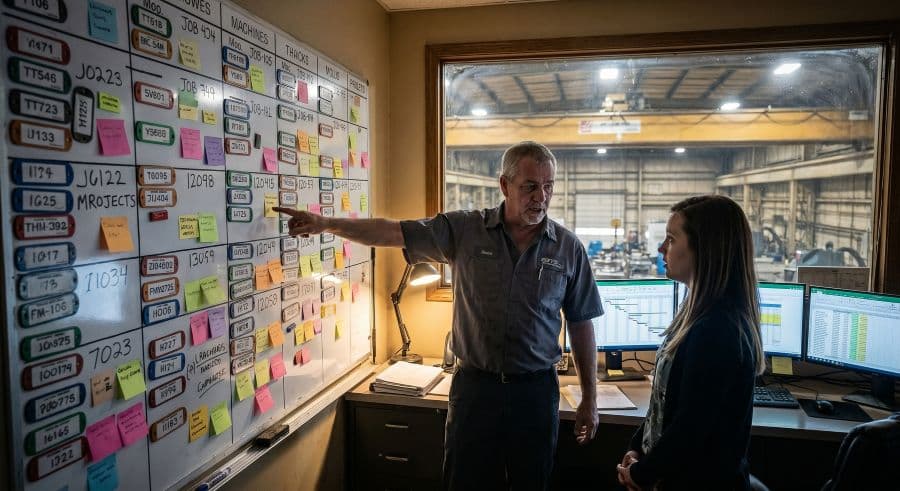
The engineering change order that doesn't care about your Gantt chart
It's week nine of a sixteen-week die build for a stamping program, and the OEM just released a revision to the part geometry. The blocks are already roughed. The detail work is half done. Two of your four wire EDM machines are committed to this tool through the end of the month, and a chunk of that committed work is now scrap or rework. The customer still expects first-shot samples on the original date.
If you run a mold or die shop anywhere in the Detroit tooling corridor, you have lived some version of that Thursday. The auto capital doesn't just assemble cars — it builds the tools that make the parts that go into the cars, and that work runs on timelines, dependencies, and customer behavior that look nothing like general contract machining.
Scheduling a mold and die shop in Detroit is its own discipline. The programs are long, the bottlenecks are narrow and expensive, and the customer can move the target after you've already cut steel. This is a look at why that combination breaks the scheduling habits most shops carry over from short-run job work — and what a workable approach looks like instead.
Why the auto capital still runs on tool and die
Every stamped panel, molded interior piece, and cast structural component starts as a tool. Before a tier 1 supplier can run a single production part, someone has to build the die that forms it or the mold that shapes it. That work has concentrated around Detroit for over a century, for the obvious reason: tooling lives close to the OEMs and tier 1s it serves, because tryout, sampling, and engineering changes all move faster when the tool and the press are a short drive apart.
That proximity is the Detroit tooling corridor's advantage and the source of its scheduling pressure. When a program team can drive to your shop on a day's notice for a tryout, your schedule is effectively shared with people who can't see it. A program review, a sampling run, a revision sign-off — each can land on your calendar with little warning and reorder everything behind it.
The shops that feel this most are the mold builders, die shops, and special-tooling makers — the ones classified under industrial mold and special die, tool, jig, and fixture manufacturing rather than general machining. They sit at the front of the supply chain, which means their schedules absorb the OEMs' timing decisions first and hardest. (For the broader regional picture, see how machine shops feed Detroit's auto tiers.)
Long-cycle programs break week-to-week scheduling
Most shop-floor scheduling tools — Excel grids, whiteboards, ERP scheduling modules — are built around a planning horizon of days to a few weeks. That works when a job arrives, runs through a handful of operations, and ships. A mold or die program doesn't behave that way. A single tool can run sixteen weeks or longer from kickoff to first shot, moving through design, roughing, heat treat, detail machining, EDM, bench, spotting, and tryout — with outside processes and supplier deliveries threaded through the whole thing.
When a program runs for months, three problems show up that short-horizon tools handle badly:
- Long dependency chains. Detail machining can't start until roughing and heat treat are done; spotting can't start until the detail work is complete. A slip early in the chain pushes everything downstream, and a week-view schedule can't show you that propagation before it hits.
- Shared constraints across overlapping programs. You're never running one tool. Five or six programs at different stages all compete for the same EDM, the same CMM, the same bench hands. The conflict is rarely visible until two jobs need the same machine the same night.
- Customer-driven change. Long programs give the customer more time to change their mind — and they use it.
This is the core of Michigan tool and die scheduling: the shops that handle long programs well stop treating each tool as a standalone job and start treating the floor as a portfolio of overlapping, multi-month programs sharing a fixed set of constraints. That shift is harder than it sounds, because the tools most shops own can't represent it. A deeper treatment of the planning-horizon problem lives in our guide to scheduling long-cycle mold and die jobs.
EDM and wire EDM are the bottleneck you schedule around
In most mold and die shops, the constraint isn't the machining centers — it's the electrical discharge machining. Sinker EDM and wire EDM are slow by nature, they often run unattended overnight, and the work that needs them tends to be the work that decides whether the tool ships on time. Cavity detail, sharp internal corners, complex profiles in hardened steel: that's EDM work, and there's rarely a faster path around it.
That changes how you schedule. On a constraint machine, the goal isn't to keep every machine busy — it's to keep the constraint fed. Practical consequences:
- Protect the EDM queue. Idle EDM time is the most expensive idle time in the building, because it's the gate the whole program waits on. Sequencing other operations to make sure a burn is always ready to start matters more than maximizing utilization elsewhere.
- Pack the unattended hours. A long burn that runs lights-out overnight is free capacity. The shops that schedule well plan which jobs go on which machine so the overnight window is always loaded with the longest, most self-sufficient burns.
- Plan for the burn that fails. When an EDM machine goes down mid-burn, the cost isn't just the repair. Unplanned downtime runs about 35% more expensive than planned downtime (Arda Cards 2026), and on a constraint machine that delay propagates into every program queued behind it.
If you can only see one machine group clearly, make it the EDM cell. Everything else can flex around it; the constraint can't.
OEM design changes don't respect your Gantt chart
The hardest part of scheduling auto tooling isn't the length of the programs — it's that the target moves. A production part gets re-released. A package change upstream forces a geometry revision. A tryout reveals a problem that needs a steel safe-side condition added. Each of those is an engineering change that lands mid-program, on a tool you've already invested weeks in.
A change order is never just rework on the floor. It re-opens dependencies you thought were closed, frees up machine time you'd already given away, and resets due dates the rest of your schedule was built around. If your schedule lives in a spreadsheet or on a whiteboard, absorbing that change means manually re-walking every downstream operation and every other program that shares the affected machines — exactly when you have the least time to do it.
Most tier-supplying tool shops also operate inside the automotive quality framework (IATF 16949), which adds documentation and traceability expectations to how changes get managed. The scheduling implication is that a design change carries an approval and paper trail that has to be sequenced alongside the metal-cutting work. What that specifically requires for your certification is a question for your registrar or auditor, not a blog post — the point here is only that the schedule has to leave room for it. Treating auto industry tooling scheduling as if the spec is frozen at kickoff is the single most common planning mistake in the corridor.
What good scheduling looks like in a Detroit tool shop
The cost of getting this wrong is quantifiable. Manual scheduling quietly eats 5–10% of revenue in a typical job shop (Qlector 2025) — for a $2M shop, that's roughly $128,000–$276,000 a year once the downstream effects are added up. And every scheduling conflict that reaches the floor costs $250–$1,000 per incident in machine restarts, resequencing, and lost capacity (Product Brief). In a long-cycle environment where one missed dependency cascades across months, those incidents compound.
A workable approach for a Detroit tool shop has three properties:
- One visual schedule for all active programs. Not one spreadsheet per program. A single view where every tool's operations sit on the same timeline against the same machines, so a conflict on the EDM in three weeks is visible today.
- Dependencies that move together. When heat treat slips or a change order lands, the downstream operations should shift as a block, not require a manual rewalk. This is the difference between a schedule and a static picture of a plan.
- Capacity you can see before you commit. Before you tell an OEM a tryout date, you should be able to see whether the constraint machines can actually carry the work. That's the heart of capacity planning for a mold and die shop — knowing what you can promise before you promise it.
We build scheduling software for SMB manufacturers, and the pattern we see most often in long-cycle shops is that the planning tool can't represent the work. A whiteboard can't show a sixteen-week dependency chain. A spreadsheet can't shift forty downstream operations when one date moves. A drag-and-drop visual schedule can — and once the whole portfolio is on one board, the overnight EDM packing and the change-order absorption stop being heroics and start being routine.
This isn't unique to Detroit. Shops in other Midwest manufacturing corridors face a related version of the long-cycle, shared-constraint problem. But the auto-tooling intensity around Detroit makes it sharper here than almost anywhere else.
One regional note worth making: the corridor doesn't stop at the river. Windsor, Ontario sits inside the same tool-and-die cluster and feeds the same OEM programs, so a Detroit-area shop's scheduling reality often extends across the border. The scheduling mechanics are identical; the customs, currency, and lead-time logistics on cross-border tool moves are not, and a shop working both sides should plan transit and clearance into the program timeline rather than treating it as a same-day drive.
Where to start
If you're scheduling auto tooling in the corridor, the move that pays off first isn't another machine or more EDM capacity — it's getting all your active programs onto one visual schedule that shows dependencies and shared constraints at the same time. Most of the lost time in a long-cycle shop isn't lost on the machines; it's lost in the gaps between programs that nobody could see coming.
If you'd rather start with a template or spreadsheet before committing to software, the resources in our store cover the fundamentals of laying out a multi-program schedule. When you're ready to see your real programs on a live board — dependencies, EDM constraints, and all — start a free trial. No credit card required, 14-day trial. The fastest way to know whether visual scheduling fits a mold die shop in Detroit is to drop your own programs onto it and watch where the conflicts surface.
Ready to go beyond the guide?
Most shops are on a live Gantt board within 60 minutes of sign-up, with their existing job list imported from Excel.
Get shop floor scheduling guides in your inbox
Practical articles for production managers — no spam, unsubscribe anytime.
Related articles
Scheduling an API-Certified Machining Operation: Traceability and Documentation Considerations
API-certified machining isn't just a quality label. It's a documentation chain that has to follow every part from raw ma…
Project-Based Scheduling for Oil & Gas Machine Shops: When the Rig Count Drives Demand
Oil & gas machining doesn't run on a manufacturing-belt rhythm. It runs on rig counts, capital project gates, and well c…
Long-Cycle Job Scheduling for Mold & Die Shops: The 12-Week Build Problem
Mold and die shops are the longest-cycle work in machining. A single program can occupy a machining center for 6–14 week…