APS vs. MRP vs. Standalone Scheduling: Which One Does a Job Shop Actually Need?
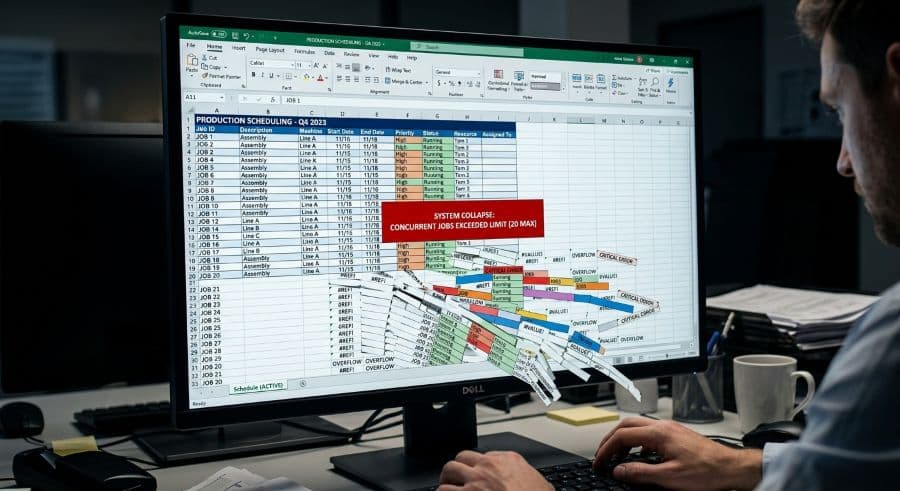
APS, MRP, and standalone scheduling are three different categories of software. They all claim to help with scheduling. Only one of them is actually b…
Blog
Practical articles for production managers and shop supervisors at SMB job shops and CNC machining centers.
Blog
Practical articles for production managers and shop supervisors at SMB job shops and CNC machining centers.

APS, MRP, and standalone scheduling are three different categories of software. They all claim to help with scheduling. Only one of them is actually b…

The schedule changes. That's not the problem. The problem is everyone finding out from a different source at a different time and reacting to a differ…

Most job shops never share their OTD numbers with customers — because they don't think the numbers look good enough. The ones that do share them often…

Every shift handoff is a scheduling reset point. The shops that run cleanly across 2nd and 3rd shift have one thing in common: a schedule that doesn't…

Most shop owners stopped running the schedule years ago. But they still need to read it — to know whether the next quarter is going to be a problem.

A scheduler asks: what's running today? A production manager asks: is the schedule we're running going to keep our customers? Different questions, dif…

If you're a new production manager at a job shop, you've inherited a scheduling system someone else built. Day 1 is about understanding it. Day 30 is …

Oil & gas machining shops don't manage demand — they manage capacity around demand they can't control. Boom-bust cycles are the operating environment,…

API-certified machining isn't just a quality label. It's a documentation chain that has to follow every part from raw material to delivery — and sched…

Oil & gas machining doesn't run on a manufacturing-belt rhythm. It runs on rig counts, capital project gates, and well completion schedules. Schedulin…

EDM is slow, expensive, and unattended-friendly. That combination makes it the most-overlooked bottleneck in mold and die scheduling.

In most job shops, the bottleneck is a machine. In a mold and die shop, it's a person. Capacity planning has to account for that.